

Cartesia vs ElevenLabs: Which Voice AI Platform Should You Choose in 2026






Choosing between Cartesia and ElevenLabs seems tricky at first because both vendors are legitimate category leaders, so the choice comes down to what you are optimizing for. Cartesia wins on real-time latency and deployment sovereignty, while ElevenLabs wins on voice range and creative platform depth. Neither ships as a complete production stack covering biometrics, agent-assist, analytics, orchestration, and models under one contract, which is where a third option enters the picture.
In simple terms: Cartesia is a race engine, ElevenLabs is a fully-equipped car, and Gnani is the entire race team that ships the engine, the car, the pit crew, the strategy, and the driver integrated on one contract to actually finish the race at production scale.
Our Methodology
We scored each platform on five criteria that matter to enterprise voice AI buyers before signing a contract. Weighting favors real-time production performance and deployment flexibility, since those are the criteria most evaluations underweight until the platform is already in production
What Are You Actually Buying?
Cartesia is a real-time voice AI infrastructure company whose Sonic and Ink models are built on State Space Models, which is the engineering reason Sonic-3.5 hits 82ms time-to-first-audio and can run on-device on consumer hardware. Cartesia's go-to-market is API-first through the Line agent platform, so the buyer's team owns everything above the model layer.
ElevenLabs is a full-suite voice AI platform for expression at scale. Its Multilingual v2, Eleven v3, Flash v2.5, Scribe v2, Music v2, Dubbing Studio, and ElevenLabs Agents cover TTS, STT, dubbing, music, and agent orchestration, with a Voice Library that exceeds 10,000 voices and India Data Residency for Enterprise customers since 31 July 2025.
Both build excellent components of a voice AI stack, but the whole stack sits with whoever assembles it.
At a Glance
Feature-by-Feature Comparison
Latency and Real-Time Performance
Cartesia Sonic-3.5 reports 82ms time-to-first-audio end-to-end with sub-90ms TTS latency, and Ink-2 delivers around 100ms transcript latency in English at launch with multilingual planned.
ElevenLabs Flash v2.5 reports around 50ms model inference latency after its February 2026 upgrade, though that figure excludes application and network overhead. End-to-end latency from India measures around 380 to 430ms after ElevenLabs' Feb 2026 multi-region deployment across US-Central, Netherlands, and Singapore that reduced India TTFB by 100 to 150ms. Humans expect conversational response inside 300ms, and callers notice the lag past that.

Verdict: Cartesia wins on real-time performance from Indian infrastructure, where ElevenLabs end-to-end latency still exceeds the conversational threshold.
Voice Quality and Expressive Range
Eleven v3 remains the category benchmark for expressive delivery through its emotional control tags, prosodic variation, and voice consistency across long-form output, making it the default for audiobooks, dubbing, and empathetic outbound CX. Voice Library exceeds 10,000 voices with cross-lingual voice cloning across 73 languages that neither Cartesia nor most other vendors match.
Cartesia has narrowed the gap, with Sonic-3.5 best-in-class for naturalness at launch in May 2026 before newer models from major labs began matching or exceeding it on public naturalness benchmarks. Sonic supports inline laughter, non-verbal expressions, and custom pronunciation dictionaries, though voice count sits closer to 500+ than 10,000+.
In production use, we have seen pronunciation stability on ElevenLabs degrade during long continuous synthesis, with volume fluctuations and repeated regenerations needed to hit consistent quality on long-form projects. Short-form voice agent turns are unaffected, though long-form audiobook or dubbing work carries a real production cost.
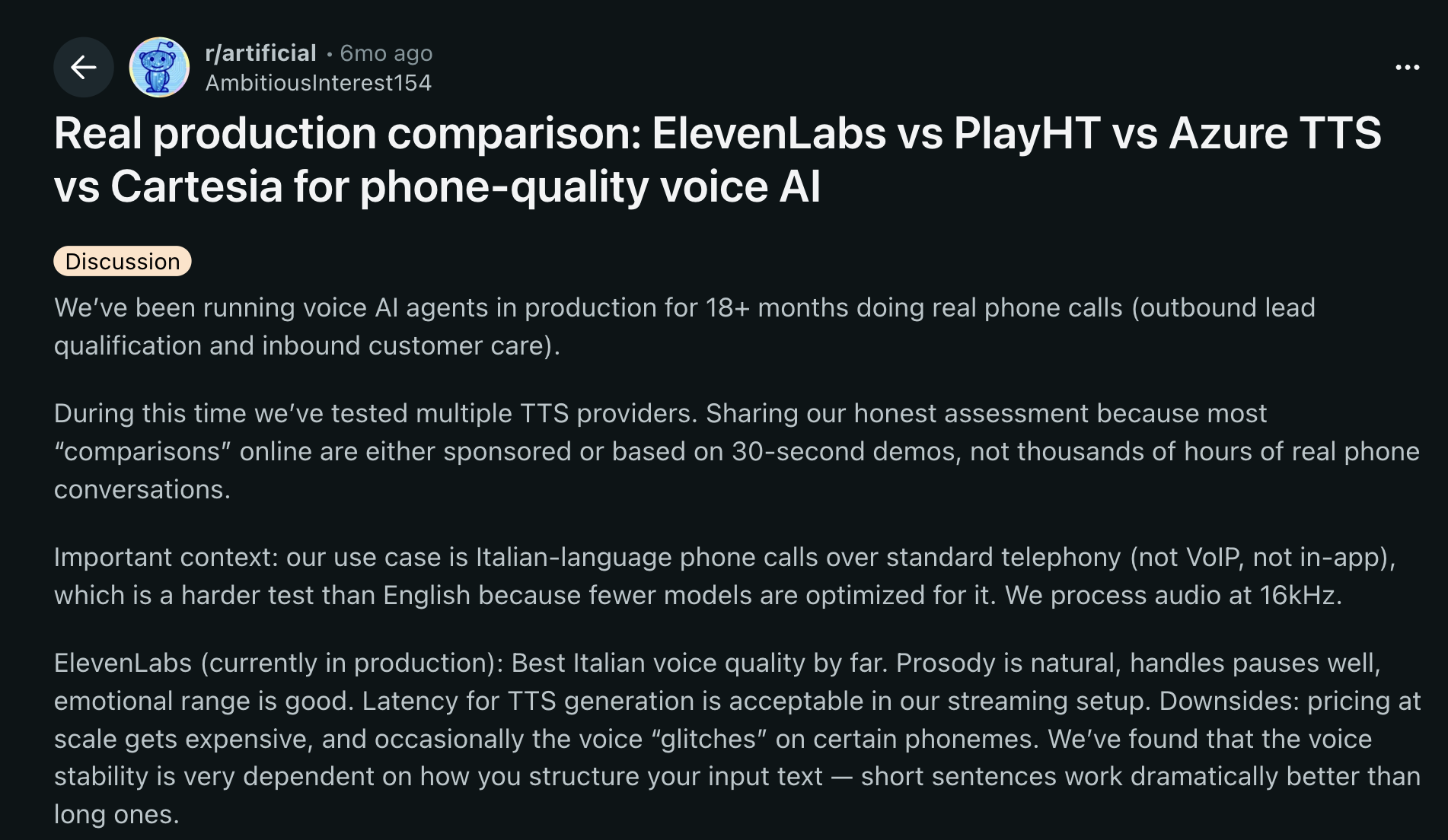
Verdict: ElevenLabs wins on voice range, library depth, and cross-lingual cloning, while Cartesia stays competitive on naturalness at short-form voice agent turns. Here's a Reddit user who has done their homework when testing each voice model for a real use case:
Indic Language and Code-Switching Depth
Cartesia lists 9 major Indian languages on its languages page covering Hindi, Tamil, Telugu, Bengali, Gujarati, Kannada, Malayalam, Marathi, and Punjabi, while ElevenLabs supports voice cloning in 12 Indian languages by adding Assamese, Nepali, and Sindhi to that set.
Neither vendor publishes Word Error Rate on noisy Indian telephony audio, so 8kHz sampling, background noise, and network compression all sit outside the tested envelope. In our own testing on Indian telephony audio, real-world Hinglish WER on ElevenLabs runs materially higher than its published demo figures, and neither vendor publishes native handling for code-switched Hindi-English speech at telephony bitrates. That gap becomes the deployment blocker for most Indian voice agents handling urban callers.
Verdict: ElevenLabs wins on language count while both lose on code-switched Indic depth at production audio quality.
Deployment Flexibility and Compliance
Cartesia supports cloud, VPC, on-premise, and on-device deployment, with Enterprise-tier deployment including air-gapped configurations.
ElevenLabs is cloud-native with data residency available in three regions including India for Enterprise customers since 31 July 2025. Zero Retention Mode is available but must be explicitly enabled, and there is no on-premise or air-gapped deployment option available today.
For any enterprise deployment requiring on-premise inference, ElevenLabs is structurally unable to fit, which rules out many scheduled commercial banks, most cooperative banks, and NBFCs handling regulated data under RBI mandates. Cartesia clears the technical bar but leaves the surrounding telephony, orchestration, and compliance scaffolding with the customer. Here's a snippet of the same Reddit post we referenced earlier:

Verdict: Cartesia wins on deployment flexibility while ElevenLabs edges slightly ahead on certification breadth. Neither publishes an explicit DPDP, RBI, IRDAI, or TRAI certification.
Pricing Transparency and Unit Economics
Cartesia public pricing runs Free at $0, Pro at $5 per month, Startup at $49, Scale at $299, and custom Enterprise, with voice agents billed at $0.06 per minute and Cartesia # telephony at $0.014 per minute.
ElevenLabs public pricing runs Free at $0, Starter at $6, Creator at $22 (with $11 first month at 50% off), Pro at $99, Scale at $299, Business at $990, and custom Enterprise, with effective TTS ranging from around $0.36 per minute at Free down to around $0.05 per minute at Business tier.
At an Indian contact-centre load of 10 million voice-agent minutes per month, ElevenLabs Business-tier list translates to roughly ₹4.15 to ₹4.3 crore per month, while Cartesia at $0.06 per minute translates to roughly ₹5 crore per month for voice agents. Enterprise pricing sits below list in both cases, though both vendors bill in USD, so the FX exposure alone becomes material at Indian contact-centre volumes.
Verdict: Both publish rate cards, which helps buyers plan. Neither bills in INR, which is a real cost at scale.
Overall Score Breakdown
Cartesia scores higher because deployment flexibility and real-time performance carry the heaviest weights, though a creative or content team evaluating purely on voice range and cross-lingual cloning would reasonably weight this differently.
Where Cartesia Wins Over ElevenLabs
- End-to-end latency at production scale. 82ms TTFA end-to-end against ElevenLabs' 50ms model-only figure that measures 380 to 430ms end-to-end from India after the Feb 2026 multi-region upgrade.
- Deployment options for regulated buyers. VPC, on-premise, and on-device deployment, none of which ElevenLabs currently offers.
- Voice agent unit economics. $0.06 per minute voice agent pricing consistently across tiers, against ElevenLabs at an effective $0.05 to $0.17 per minute depending on plan.
- Architectural efficiency. SSMs scale linearly with input length and enable efficient on-device inference, an efficiency advantage transformer-based platforms have to work harder to match.
Where ElevenLabs Wins Over Cartesia
- Voice library depth. 10,000+ voices against Cartesia's 500+, with cross-lingual cloning across 73 languages that is genuinely category-leading and hard to replicate.
- Emotional expressiveness for long-form. Eleven v3's dramatic performance controls remain the benchmark for audiobooks, dubbing, and empathetic content work.
- Platform breadth beyond TTS. Music v2, Dubbing Studio, Scribe STT with 90+ languages, and ElevenLabs Agents combine into a wider creative surface than Cartesia offers.
- Certification depth. ISO 27001 and PCI DSS Level 1 alongside SOC 2 Type II and HIPAA-ready give ElevenLabs a slightly broader public compliance footprint for procurement teams that check every box.
- India Data Residency for Enterprise customers. Voice and customer data held within Indian infrastructure since 31 July 2025, cloud-only but a real answer for teams that need India data localization without on-premise.
Where Both Fall Short: Real-World Enterprise Scenarios
Scenario 1. BFSI: a Tier-1 private bank building a Hindi collections voice agent
500K delinquent accounts per month across metro and tier-2 Hindi-speaking customers, with empathetic caller experience needed, end-to-end latency under 400ms, voice data as customer PII under RBI expectations, and callers routinely code-switching between Hindi and English mid-sentence.
- Cartesia fits if the bank's internal team can build the orchestration, telephony, and compliance layers around Cartesia's API, callers stay in tier-1 Hindi with minimal code-switching, and sub-100ms latency with $0.06 per minute economics carry the deployment.
- ElevenLabs fits if the bank prioritizes empathetic prosody over unit economics and sits on Enterprise tier for India Data Residency, though cloud-only architecture rules out on-premise infosec review.
- Where both fall short: code-switched Hinglish WER at telephony bitrates, on-premise deployment for the bank's infosec team, and pre-packaged RBI-aligned compliance workflows all sit outside what either platform ships natively.
Scenario 2. Insurance: a pan-India insurer running multilingual welcome and renewal calls
200K welcome calls plus 500K renewal calls per month across 8+ Indian languages including Tamil, Kannada, Marathi, and Bengali, with policyholders outside metros expecting regional-accent authenticity, IRDAI expectations for outbound communication, and voice biometrics increasingly used for consent capture during policy servicing.
- Cartesia fits if the insurer only needs tier-1 languages, has developer capacity to build the multilingual routing layer, and can accept generic accents rather than regional ones.
- ElevenLabs fits if the insurer wants a single cloned brand voice speaking multiple languages cross-lingually and can source consent-capture biometrics separately.
- Where both fall short: regional-accent variants inside a language such as Chennai Tamil versus Coimbatore Tamil or Kolkata Bengali versus Silchar Bengali, voice biometrics as a first-party product for consent capture, and IRDAI-aligned outbound workflows out of the box.
Scenario 3. Healthcare: a multi-city hospital chain running outpatient engagement
300K appointment reminders plus 100K post-consult follow-up calls per month, with prescription refill and lab-result queries requiring caller authentication before releasing PHI, patient audio under HIPAA plus DPDP, callers speaking Hindi, Tamil, Bengali, and Marathi predominantly on inconsistent mobile-line audio, and compliance review requiring on-premise or private-cloud deployment inside the hospital's own tenancy.
- Cartesia fits if the hospital IT team can source voice biometrics separately for patient identity verification, HIPAA-with-BAA is sufficient, and on-premise deployment is available at Enterprise tier.
- ElevenLabs fits if the hospital accepts cloud-only architecture under HIPAA-with-BAA, patient interactions stay in tier-1 languages, and identity verification happens outside the voice agent via SMS OTP or portal login.
- Where both fall short: first-party voice biometrics for patient identity verification before releasing PHI, and Indic-language depth on inconsistent mobile audio. Neither ships biometrics in the same contract as STT and TTS, which creates a compliance seam across two suppliers for a workflow where every data handoff is a HIPAA event.
Scenario 4. Retail and E-commerce: a large D2C brand running order support at festive-season scale
2M+ monthly customer interactions during festive periods covering order tracking, returns, delivery reschedules, and refund status across English plus Hindi plus 4 regional languages, with peak-day concurrency spikes at 8x baseline, thin unit margins compounding per-minute cost fast, and callers including tier-2 and tier-3 customers on noisy mobile lines.
- Cartesia fits if the retailer's platform team can build the peak-scaling infrastructure and tier-1 language coverage is sufficient, with the $0.06 per minute voice-agent rate holding unit economics steady at scale.
- ElevenLabs fits if cross-lingual brand voice matters for the retailer's positioning and Business-tier volume commitment around $0.05 per minute at $990 per month is manageable against margin.
- Where both fall short: concurrent-session capacity during festive peaks, tier-2 and tier-3 Indic-language depth on noisy audio, and analytics for post-call QA across millions of interactions. Cartesia's public Scale tier caps at 15 concurrent TTS, ElevenLabs' ceiling is undisclosed above published tiers, and neither ships first-party conversation intelligence for QA at that volume.
Scenario 5. Telecom: a national telco building a 40M-call-per-day IVR
Postpaid billing, plan changes, outage notifications, and self-service across a 40M-daily-call footprint, with TRAI DLT compliance for outbound, sub-500ms end-to-end latency, and unit economics that survive INR revenue per call.
- Cartesia fits if the telco has an internal platform team assembling telephony, DLT compliance, and orchestration around Cartesia's APIs, with latency and per-minute economics competitive while assembly cost stays with the customer.
- ElevenLabs fits if the telco needs richer no-code agent orchestration and callers are urban English and Hindi speakers on Enterprise-tier India Data Residency.
- Where both fall short: concurrency at telco scale, native speech-to-speech versus cascaded STT-to-LLM-to-TTS pipelines that stack latency and GPU cost at each layer, and TRAI DLT automation out of the box.
Where Gnani Wins Over Both
Both Cartesia and ElevenLabs sell excellent parts of a voice AI stack without selling the whole stack, and Gnani was built to close that gap. Cartesia is the engine and ElevenLabs is the car, while Gnani ships the engine, the car, the pit crew, the strategy, and the driver all integrated on one contract.
Every product below runs on the same platform, under one contract, with one deployment posture.
- Prisma (STT): 10+ Indian languages with under 4% WER on Indian speech recognition, 96% code-switch accuracy on Hinglish, Tanglish, and other code-mixed dialects, sub-200ms streaming latency, and training on 14M+ hours of real-world telephonic audio.
- Timbre (TTS): 12+ Indian languages at 4.23 MOS with sub-250ms p95 latency, and regional accent variants across Chennai Tamil, Kolkata Bengali, Ahmedabad Gujarati, and Pune Marathi that global models do not differentiate.
- Warp (Speech-to-Speech): A 5B-parameter native speech-to-speech model with no STT-TTS intermediary text layer, pretrained on 15M hours of multilingual speech plus 8T text tokens, running under 200ms latency with 60% GPU compute reduction versus cascaded pipelines.
- Evon (Small Language Models): Domain-tuned SLMs for enterprise voice with low hallucination rates, ranked #1 on the Berkeley Function-Calling Leaderboard v3 for tool-calling accuracy that maps directly to production voice agent reliability.
- Biometrics: Voice authentication via voiceprint that verifies caller identity in place of OTPs and captures consent during KYC, which neither Cartesia nor ElevenLabs offers as a first-party product.
- Assist (Live Agent Co-pilot): Real-time compliance prompts and next-best-action hints for a human agent during a live call, a first-party layer neither Cartesia nor ElevenLabs ships today.
- Analytics: Conversation intelligence and QA across every call with sentiment tagging and compliance review built into the platform.
- Agent Studio and orchestration: No-code agent builder plus workflow orchestration, prompt management, and guardrails on top of everything above.
Gnani's platform runs 30M+ voice interactions daily at 35,000+ concurrent sessions with 99.9% uptime SLA, and deployment supports cloud, hybrid, on-premise, and air-gapped configurations with SOC 2 Type 2, ISO 27001, HIPAA, and GDPR certifications published. Named-entity recognition for Indian identifiers like PAN, Aadhaar, policy numbers, and UPI IDs is built into the STT layer natively, and Samsung selected Gnani to co-develop the Live Translate feature in the Galaxy AI series.
On benchmarks, Prisma STT was tested on the KathBath-Noisy dataset against ElevenLabs Scribe v2, Microsoft Azure STT, and Sarvam Saaras v3 across 9 major Indic languages, delivering lower WER across 8 of the 9 languages tested with margins ranging from 1.4 percentage points on Punjabi to 5.1 percentage points on Malayalam.
How to Choose
Final Verdict
Cartesia is a race engine and ElevenLabs is a fully-equipped car, and both are excellent at what they do. Under our methodology which weights real-time performance and deployment flexibility most heavily, Cartesia scores higher at 80/100 against ElevenLabs at 70/100, though ElevenLabs closes and often overtakes that gap for content and dubbing workloads where voice range and cross-lingual cloning matter most.
Neither ships a complete voice AI stack covering STT, TTS, voice biometrics, live agent-assist, analytics, orchestration, on-premise deployment, and Indic regional-accent depth under one contract. Gnani's core offer is that they do sit inside one contract, and the platform runs at production scale today.
Whichever way you go, run all three against a real call recording from your own environment in your own languages and dialects before signing anything.
Frequently Asked Questions
What is the main difference between Cartesia and ElevenLabs?
Cartesia is a real-time voice AI infrastructure company built on State Space Models, optimized for the lowest possible latency at 82ms TTFA end-to-end with cloud, VPC, on-premise, and on-device deployment. ElevenLabs is a full-suite voice AI platform for expressive content with 10,000+ voices, cross-lingual cloning across 73 languages, and orchestration for dubbing, music, and agents. Cartesia is a race engine tuned for one thing, while ElevenLabs is a fully-equipped car built for creative range.
Which TTS API has the lowest latency for real-time voice agents?
Cartesia Sonic-3.5 currently reports the lowest end-to-end latency at 82ms time-to-first-audio. ElevenLabs Flash v2.5 reports around 50ms model inference latency after its February 2026 upgrade, but end-to-end latency from India measures around 380 to 430ms after the Feb 2026 multi-region deployment, still above the 300ms conversational threshold.
Does ElevenLabs support Hindi and Indian languages?
Yes. Voice cloning is supported in 12 Indian languages (Hindi, Assamese, Bengali, Gujarati, Kannada, Malayalam, Marathi, Nepali, Punjabi, Sindhi, Tamil, and Telugu) with cross-lingual synthesis into 73 languages total. In our own testing, real-world code-switched Hinglish WER on ElevenLabs runs materially higher than its published demo figures on noisy telephony audio.
Does Cartesia work on-premise?
Yes. Cartesia supports cloud, VPC, on-premise, and on-device deployment on Enterprise-tier contracts, and air-gapped deployment is technically feasible in a way ElevenLabs cloud-only architecture is not.
Is Cartesia or ElevenLabs cheaper?
Cartesia entry pricing is lower at $5 per month for Pro against ElevenLabs at $6 per month for Starter, and voice-agent per-minute rates are consistently lower at $0.06 per minute. ElevenLabs' effective TTS cost drops to around $0.05 per minute at Business tier ($990 per month), and the Creator tier lists at $22 per month with the first month at $11. Both bill in USD, which is a material FX exposure for Indian buyers at contact-centre scale.
Do Cartesia or ElevenLabs support DPDP or RBI compliance?
Neither vendor explicitly certifies DPDP, RBI, IRDAI, or TRAI compliance in public documentation. Both hold SOC 2 Type II and GDPR, ElevenLabs additionally publishes ISO 27001 and PCI DSS Level 1, and Cartesia publishes HIPAA and PCI. ElevenLabs launched India Data Residency (Enterprise-only) on 31 July 2025.
What is the best voice AI platform for BFSI voice agents in India?
No global vendor ships STT, TTS, voice biometrics, agent-assist, and analytics as first-party products in the same contract with on-premise deployment and Indian regulatory alignment. Cartesia clears on-premise deployment technically but leaves the surrounding stack with the customer, while ElevenLabs clears certification breadth but not on-premise. Gnani ships the full stack under one contract with on-premise, hybrid, and air-gapped deployment as standard options.
How does Gnani AI compare to ElevenLabs and Cartesia?
Cartesia and ElevenLabs each ship excellent parts of a voice AI stack, while Gnani ships the whole stack including STT (Prisma), TTS (Timbre), speech-to-speech (Warp, currently in Beta), domain-tuned SLMs (Evon at #1 on Berkeley Function-Calling Leaderboard v3), voice biometrics, live agent-assist, analytics, and orchestration all under one contract. Prisma STT outperforms ElevenLabs Scribe v2, Microsoft Azure STT, and Sarvam Saaras v3 on the KathBath-Noisy benchmark across 8 of 9 major Indic languages tested, and the platform runs at 30M+ daily calls and 35,000+ concurrent voice sessions in production with cloud, hybrid, on-premise, and air-gapped deployment options.
How fast can I deploy a voice agent with each platform?
Cartesia's Line platform is code-first, so go-live is bounded by how quickly your team can build the surrounding orchestration. ElevenLabs Agents ships as a more mature no-code layer. Gnani states production-ready deployment in under 5 minutes for standard agent configurations, though every figure is best-case and should be validated against your own integration complexity across CRM, telephony provider, and compliance review.
Which platform is better for regulated industries?
Cartesia's on-premise and air-gapped support gives it a real edge over ElevenLabs for regulated buyers, since ElevenLabs cloud-only architecture (even with India Data Residency) does not meet on-premise requirements common at Indian public sector banks. For deployments that need on-premise plus voice biometrics plus agent-assist plus analytics in one contract, Gnani carries the broadest full-stack footprint today.
