

Gnani AI vs Bolna: Enterprise Voice AI Comparison 2026






TL;DR
A voice agent can look impressive in a demo and still create a very different experience once real customers start calling.
The controlled demo usually has one speaker, a clean connection, a predictable question and a carefully prepared answer. Production calls bring interruptions, regional accents, code-switching, incomplete sentences and questions the agent was never explicitly designed to answer. The agent also has to work with the systems around it, whether that means retrieving customer information, updating a CRM, following a business rule or handing the conversation to a human.
That makes the choice between Gnani and Bolna less about who has the better demo and more about how each platform approaches the underlying Voice AI stack.
Gnani owns its speech and language models and builds its agent, analytics and enterprise products around them. Bolna takes a modular approach, allowing teams to choose their own STT, LLM, TTS and telephony providers.
Both approaches make sense. A technical team that wants to control the individual components of its stack may prefer Bolna. An enterprise that wants more of the AI stack provided and operated as one platform may prefer Gnani, particularly when Indian-language voice interactions are central to the use case.
This blog is to help you understand when you should use Gnani and when you should use Bolna, depending on your specific requirements.
Our Scoring Methodology
We evaluated the two platforms against five criteria that cover the main decisions an enterprise has to make before putting Voice AI into production.
At a Glance
The two platforms start from different assumptions about what the customer should control.
Gnani's own speech and language models sit underneath its agent platform, while Bolna gives customers the ability to select the providers underneath theirs. That difference carries through the rest of the products.
Feature-by-Feature Comparison
Speech-to-Text
Speech recognition is one of the first places where a voice agent can fail. A strong language model cannot compensate for a transcription layer that consistently mishears names, numbers, accents or words spoken over poor telephone audio. This becomes particularly relevant for Indian-language deployments, where callers may move between languages or use regional varieties within the same conversation.
Gnani addresses this through Prisma, its own speech recognition model. Gnani positions Prisma for multilingual and code-switched speech, with support for Indian accents and telephonic audio. The speech layer is part of the same stack as the language models and agent platform rather than being sourced from a separate provider.
Bolna gives customers more choice at this layer. Its integrations include providers including Deepgram, Sarvam and OpenAI, allowing a team to select the transcription service that fits a particular use case and change providers later if needed.

That flexibility is useful when the engineering team has strong preferences about its speech stack or already has relationships with specific providers. Gnani is more attractive when the enterprise wants the speech layer to come as part of the platform and wants its Indian-language capabilities handled by the same vendor responsible for the rest of the agent.
Winner: Gnani
Text-to-Speech
Gnani's Timbre provides multilingual speech synthesis designed for conversational use, with support for expressive prosody and streaming. Because it sits alongside Prisma and Evon, the speech and language layers are managed as parts of the same platform.
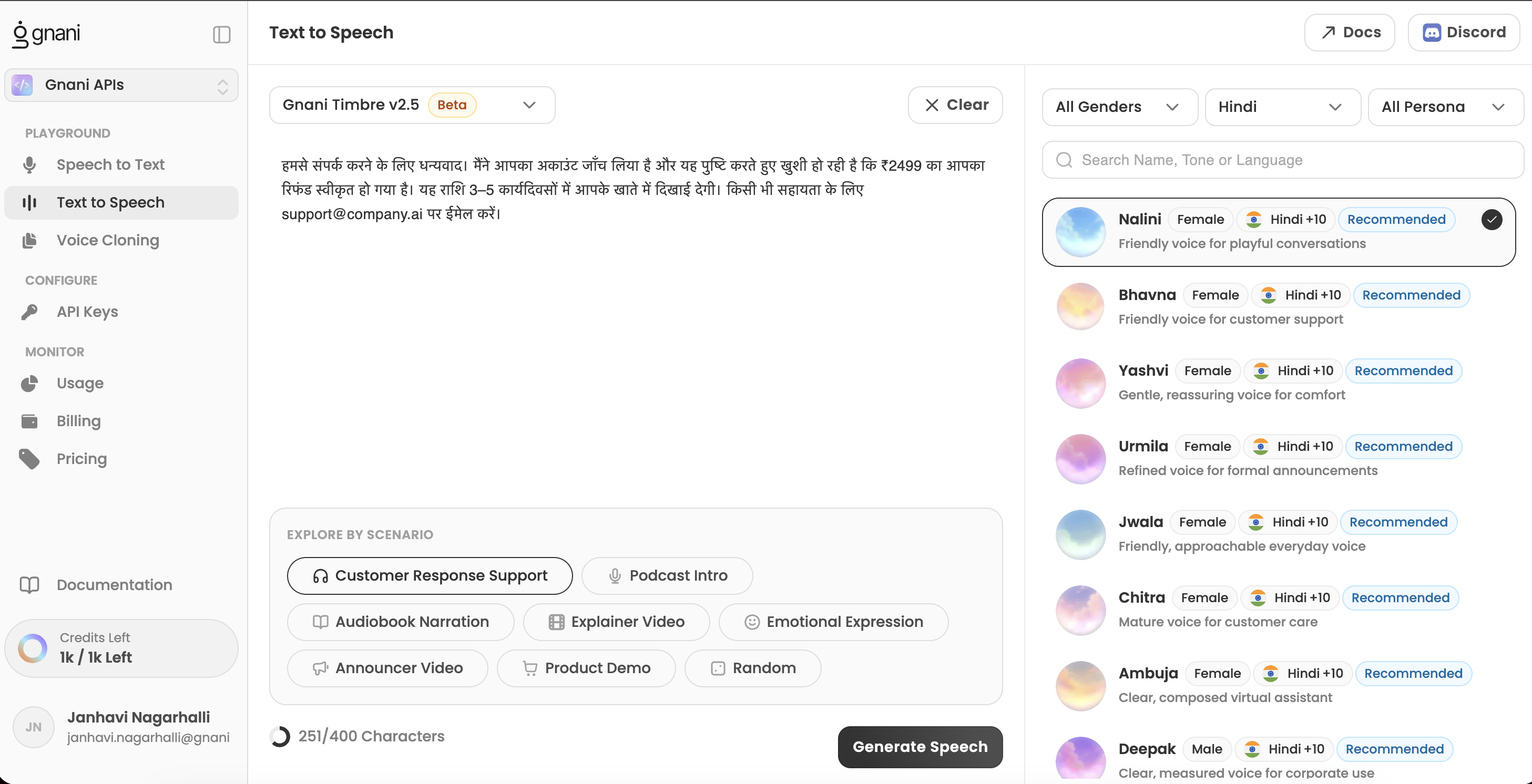
Bolna instead gives customers a selection of TTS providers, including Cartesia, ElevenLabs, Rime and Sarvam. That is valuable for teams that want to test different voices or use an existing provider they already trust. Bolna also supports voice cloning through external providers.
Bolna gives the buyer greater freedom over the individual voice provider, while Gnani gives the buyer a more integrated speech stack. A team that expects to change TTS providers frequently may value Bolna's flexibility more than the convenience of an integrated model stack.
Winner: Bolna on provider choice; Gnani on integration
Indian Languages
Language support deserves more scrutiny than a number on a languages page.
For a production voice agent, supporting a language means more than producing a recognisable transcription or generating speech in that language. The agent has to understand the caller, respond naturally, handle the way people actually speak on the telephone and cope when a conversation moves between languages.
Gnani's models are built around multilingual and Indian-language use cases. Its published product information covers 40+ languages and dialects, with deeper support across Indic languages. Gnani also supports language detection and switching for conversations where callers move between languages.
Bolna can support Indian-language agents through its provider ecosystem. Sarvam, for instance, is available as an option alongside other speech providers, giving customers the ability to select different models for different requirements.
The distinction is useful for buyers with a specific language mix. Bolna's approach gives an engineering team the freedom to find the best provider for each language. Gnani's approach makes Indian-language speech a native part of the platform rather than a collection of external components.
For a business running voice operations across multiple Indian languages, the latter is a stronger starting point.
Winner: Gnani
Agent Building
Both platforms have moved well beyond the idea of a voice agent as a scripted phone tree.
Gnani's Agent Builder lets teams create agents without building every component from scratch. Agents can retrieve information, connect to enterprise systems, execute workflows, apply guardrails and hand conversations to humans. The platform also supports multi-agent orchestration and integrations with business applications.
Bolna's Agent Studio offers a similar visual approach, while its APIs give engineering teams another route for building custom applications. Agents can use workflows, integrations, knowledge bases and guardrails rather than being limited to fixed conversational scripts.
The important difference is what sits underneath the builder. Bolna's agent layer is designed to work with the providers selected by the customer. Gnani's builder sits on top of Gnani's own speech and language models and the rest of its enterprise platform.
That makes Bolna particularly attractive to engineering-led teams that want to shape the underlying stack themselves. Gnani has the stronger proposition for organisations that want the agent builder and the AI stack to arrive as one system.
Winner: Bolna, narrowly
Knowledge, RAG and Guardrails
Enterprise agents need access to company knowledge, but retrieval alone does not make an agent reliable. The system also needs to determine what information it should use, what actions it is allowed to take and when a human should take over.
Gnani's agent tooling combines RAG with citations, guardrails, confidence thresholds, workflow actions and human handoff. That allows knowledge retrieval to sit inside a broader workflow rather than functioning as a separate question-answering layer.
Bolna supports knowledge bases built from PDFs and URLs and uses RAG to provide agents with retrieved information. Its Agent Studio also includes built-in guardrails.
Both platforms can connect an agent to business knowledge. Gnani has the stronger offering when the requirement extends from answering questions into executing enterprise workflows around that knowledge. Bolna's strength is the flexibility to assemble the surrounding stack according to the team's own requirements.
Winner: Gnani, narrowly
Analytics and Agent Assist
A voice operation needs to know what customers are asking, where conversations are breaking down, whether agents are following procedures and which calls deserve review. Human agents also need support when a conversation is handed over to them.
Gnani has built these functions into the platform. Its Conversation Analytics product supports conversation analysis, topics, sentiment, compliance, agent performance and automated QA.
Gnani also offers Agent Assist for human-led conversations, with features including live transcription, knowledge retrieval, suggested actions, summaries and workflow guidance.
Bolna provides call analytics through webhooks, summaries, structured extraction and integrations with downstream systems. That can work well for teams that already have their own operational systems and want voice data to feed into them.
The difference is one of product scope. Bolna gives the engineering team the data and interfaces to build around the agent. Gnani provides more of the operational layer itself.
Winner: Gnani
Voice Biometrics
Voice authentication sits outside the usual agent-building workflow, but it can matter considerably in sectors where confirming identity is part of the call.
Gnani has a dedicated Voice Biometrics product for authentication and fraud detection. It supports detection of synthetic, recorded and replayed voices and is designed to work across languages.
No equivalent first-party voice biometrics product is documented in the Bolna materials reviewed.
For an enterprise that needs voice authentication alongside its conversational agent, having that capability within the same product family is a meaningful advantage.
Winner: Gnani
Pricing & Provider Flexibility
Pricing is one area where Bolna has a straightforward advantage for teams that want to understand their starting economics before entering an enterprise procurement process.
Bolna publishes usage-based pricing and also offers Enterprise plans. Its platform supports BYOK for LLM, TTS and ASR providers, which gives customers more control over both the providers they use and how those provider costs fit into their deployment.
Gnani uses enterprise pricing, which allows commercial terms to account for the requirements of a particular deployment, including the combination of languages, integrations, deployment model and support requirements.
The difference is less about one platform being universally cheaper. A modular platform can have more moving parts in the bill, particularly when external AI and telephony providers are involved. An integrated enterprise platform may have a less transparent starting price but reduce the number of vendors and components the buyer has to manage.
For teams that value public pricing and the ability to choose their underlying providers, Bolna is the stronger fit.
Winner: Bolna
Overall Score Breakdown
Where Gnani Wins Over Bolna
Gnani's strongest advantage is the amount of the Voice AI stack it owns and brings together.
The platform covers speech recognition, speech synthesis and language models, then extends into agent orchestration, analytics, human-agent support and voice authentication. An enterprise can therefore evaluate more of its voice operation through a single platform instead of assembling a collection of specialised products.
That is particularly useful when Indian-language voice is central to the deployment. Prisma, Timbre and Evon give Gnani control over the underlying speech and language layers, while the agent platform provides the workflow and enterprise integrations around them.
The same approach extends into sovereign AI through Gnani Artha, which brings Gnani's models and platform into infrastructure controlled by the customer. Gnani Artha
For enterprises that want to reduce the number of moving parts in their Voice AI stack, that integrated approach is Gnani's strongest argument.
Where Bolna Wins Over Gnani
Bolna's strongest advantage is the freedom it gives technical teams.
An enterprise can choose its LLM, select an STT provider for a particular language, use a different TTS provider, bring its own keys and change those components as its requirements change. That is valuable in a market where model quality, pricing and availability can shift quickly.
The same flexibility is useful for companies that already have preferred AI providers or internal infrastructure standards. Bolna can fit around those decisions rather than asking the team to replace them with a single vendor's models.
Its public pricing also makes early experimentation easier to scope. A team can start with a known usage model before negotiating an Enterprise arrangement.
Bolna is therefore a strong choice when the engineering organisation wants to retain ownership of the technology decisions underneath the voice application.
How to Choose
There is one question worth putting to the engineering team before making the choice:
How much of the underlying Voice AI stack do we actually want to own?
If the answer is "most of it," Bolna's architecture will likely make more sense. If the answer is "as little as possible while retaining enterprise control," Gnani's integrated approach is more compelling.
The same question should be asked of the operations team. If analytics, QA, Agent Assist and voice authentication will all need separate systems, the apparent simplicity of choosing a modular platform can disappear once the full production stack is assembled.
Final Verdict
Gnani and Bolna are both strong choices, but they suit different buying priorities.
Choose Gnani if you want a more integrated Voice AI platform, particularly for Indian-language deployments and enterprise use cases where speech, agents and operational tooling need to work together.
Choose Bolna if your engineering team values provider flexibility and wants more control over the models and services underneath the agent.
For enterprises that want to spend less time assembling the stack and more time deploying Voice AI, Gnani is the stronger choice.
Want to see how these platforms compare on enterprise grade performance more broadly? Refer to our master comparison page.
Frequently Asked Questions
What is the main difference between Gnani and Bolna?
Gnani builds its own speech and language models and combines them with an enterprise Voice AI platform. Bolna provides an orchestration platform where customers can select their own STT, LLM, TTS and telephony providers.
Is Bolna enterprise-ready?
Yes. Bolna offers Enterprise plans, self-hosted deployment, data residency options, integrations and tooling for organisations running Voice AI in production.
Does Bolna support on-premise deployment?
Yes. Bolna supports self-hosted enterprise deployments across cloud and on-premise environments.
Does Bolna support India data residency?
Yes. Enterprise customers can choose India data residency.
Does Gnani support on-premise deployment?
Yes. Gnani supports SaaS, private cloud, on-premise and hybrid deployments, with air-gapped deployment available for qualifying enterprise requirements.
Which platform is better for Indian languages?
Gnani has the stronger native proposition because its speech and language stack is designed around Indian-language use cases. Bolna can also support Indian-language deployments through its provider ecosystem.
Does Bolna support BYOK?
Yes. Bolna supports customer API keys for LLM, TTS and ASR providers.
Does Bolna have public pricing?
Yes. Bolna publishes usage-based pricing alongside custom Enterprise plans.
What is Gnani Artha?
Gnani Artha is Gnani's sovereign AI offering. It combines Gnani's models and platform with infrastructure designed to run inside a customer's data centre or VPC.
Which is better for an enterprise, Gnani or Bolna?
Gnani is the stronger fit when Indian-language speech, an integrated Voice AI stack, enterprise operations and control over the AI deployment are the priorities. Bolna is the stronger fit when provider flexibility, BYOK, developer control and public usage-based pricing matter more. The decision comes down to how much of the Voice AI stack your organisation wants to assemble and operate itself.
