

Gnani AI vs Ringg AI: Which Voice AI Agent Platform Should You Choose?






TL;DR
Gnani AI and Ringg AI are both built in India and handle code-mixed speech that global vendors long treated as an edge case. The difference sits in how much of the stack each company owns and how far the deployment envelope stretches.
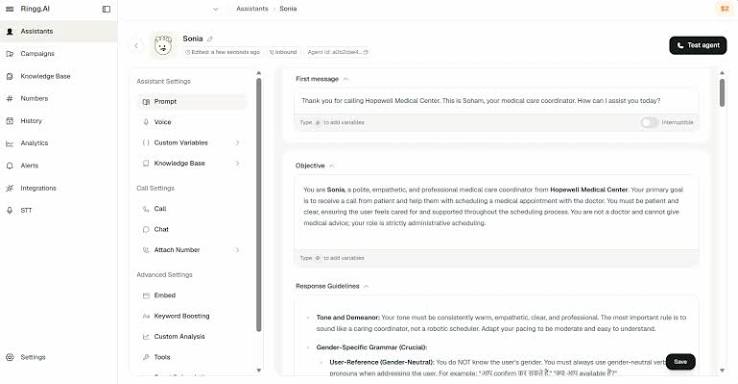
Ringg AI is a self-serve multichannel agent platform. It publishes a rate card, ships a no-code builder, runs its own Hindi speech recognition model, and is designed so a growth or operations team can launch a campaign without a platform engineering function behind it.
Gnani is a full-stack voice AI platform where the speech recognition, text-to-speech, speech-to-speech and language models are all first-party, and where voice biometrics, live agent assist, conversation analytics and orchestration sit inside the same contract as the agents. Gnani Artha extends that into a sovereign deployment posture, with open-weight Indic language models running inside a customer's own data centre.
If your evaluation is weighted toward speed of launch and predictable per-minute pricing, Ringg AI is the more direct route. If it is weighted toward model ownership, regulated-industry deployment, and having authentication and analytics under the same contract as the agent, Gnani takes on more of the build for you.
Our Methodology for Comparing Gnani AI and Ringg AI
We scored each platform on five criteria that map to what an enterprise buyer has to de-risk before signing, in place of what reads well on a feature grid. The weighting favours model ownership and deployment flexibility, which most voice AI evaluations underweight until the platform is already carrying production traffic and a security review lands on the desk.
Gnani AI vs Ringg AI: What Are You Actually Buying?
Ringg AI is a multichannel conversational agent platform. A single agent configuration deploys across voice, chat, WhatsApp and web without being rebuilt per channel, and the company has extended into browser agents. The platform advertises 20 or more languages and dialects, with eight or more major Indian languages and 16 or more regional accents.
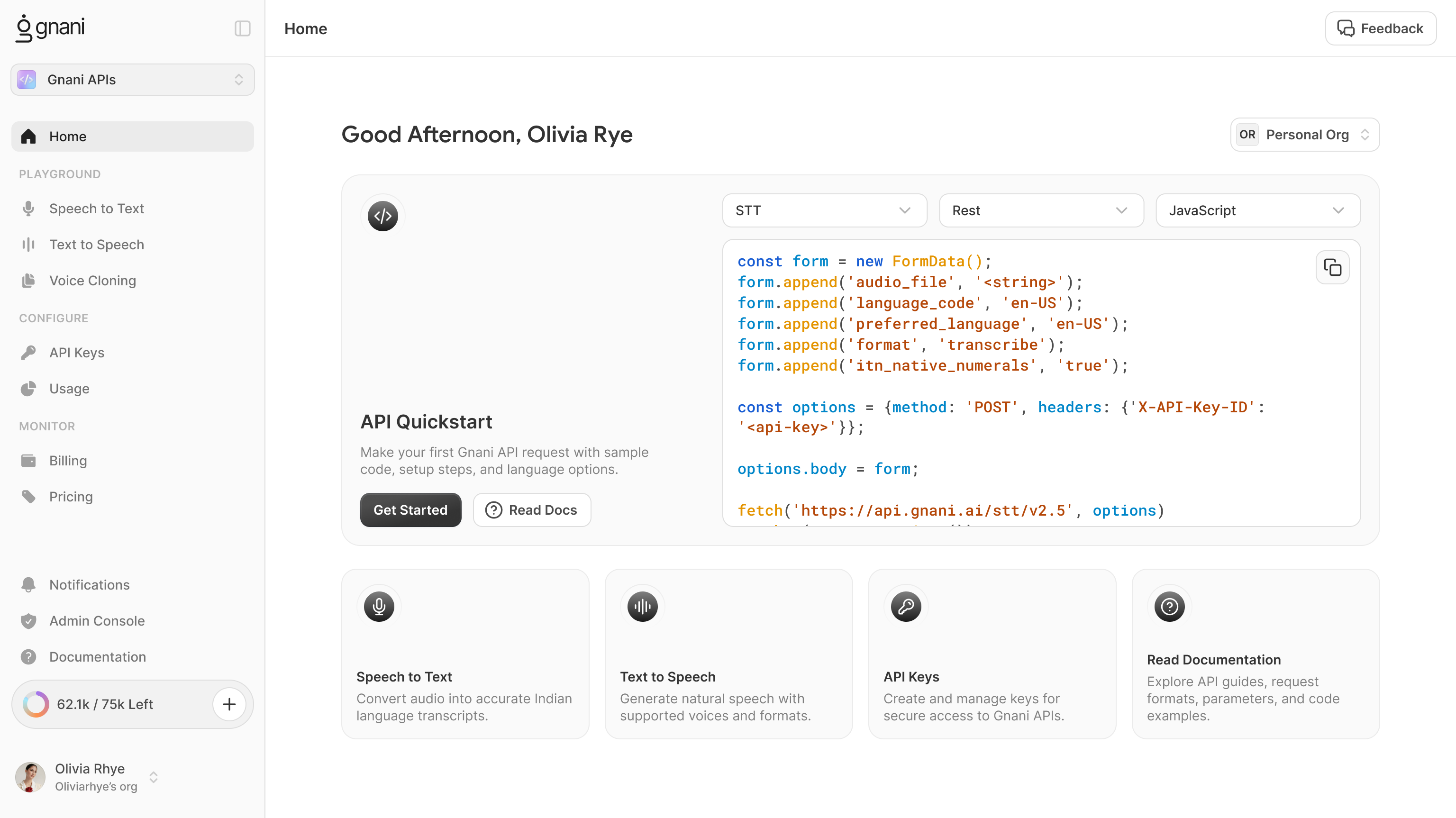
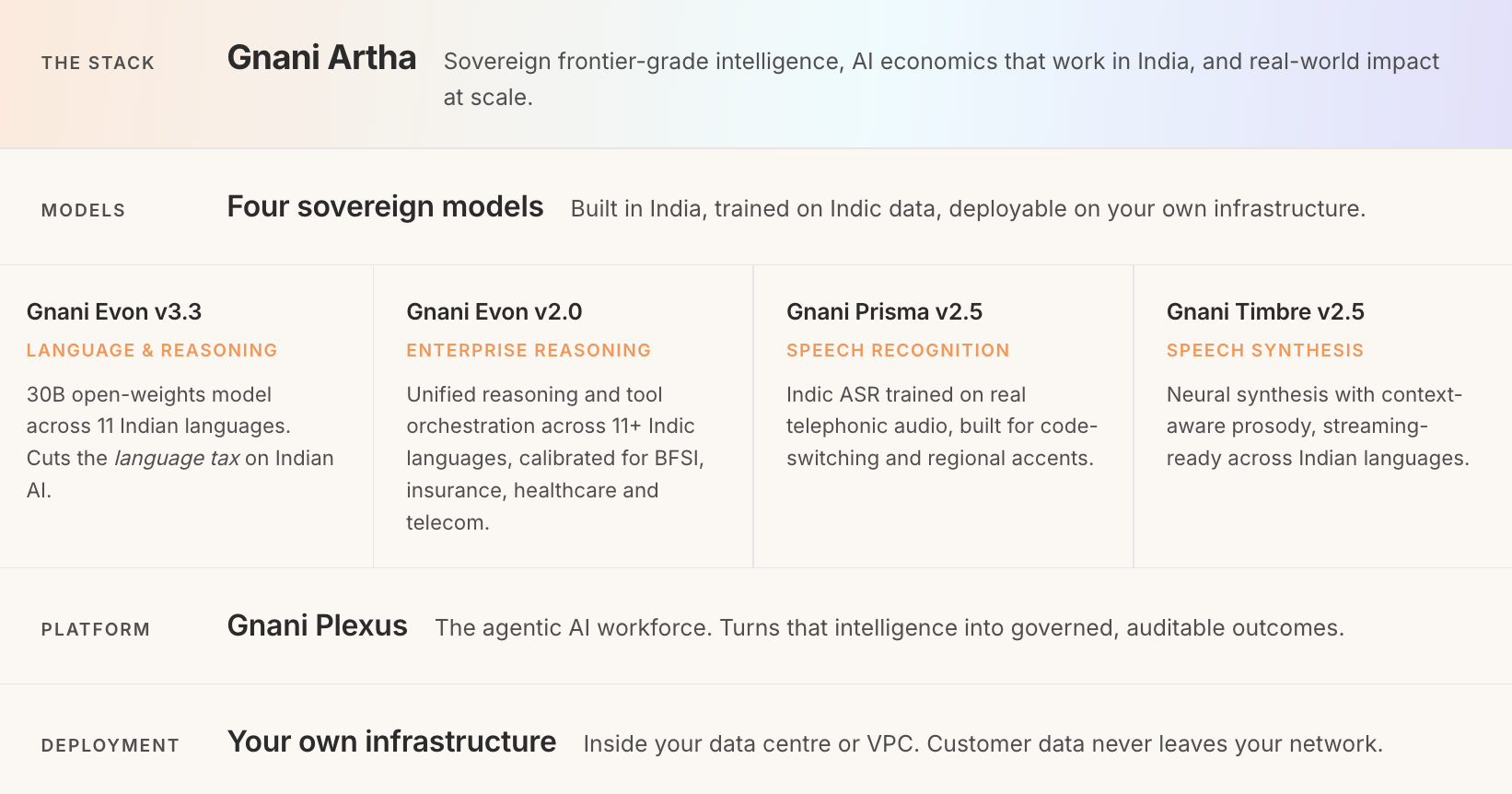
Gnani AI is a full-stack voice AI platform built on first-party models. The model portfolio covers speech recognition (Prisma v2.5), text-to-speech (Timbre v2.5), native speech-to-speech (Warp v2.0), and small language models tuned for enterprise reasoning and tool calling (Evon v2.0 and Evon v3.3). Above the models sit four enterprise products: Gnani Agents for automated conversations across voice, WhatsApp, chat and SMS; Analytics for conversation intelligence and automated QA; Biometrics for voice-based caller authentication; and Assist for real-time guidance to agents on live calls. Gnani also handles 30 million or more voice interactions daily across 200 or more enterprise deployments, with cloud, private cloud, on-premise and air-gapped deployment.
We also added Artha, a sovereign AI stack that packages the Evon, Prisma and Timbre models with an agentic orchestration platform called Plexus, designed to run inside a customer's own data centre or VPC. Evon v3.3, the frontier model in that stack, is published under an Apache 2.0 licence with open weights available on request.
At a Glance
Feature-by-Feature Comparison
Model ownership: first-party stack vs assembled stack
Gnani builds and trains every layer of its own pipeline. Prisma v2.5 is an Indic speech recognition model trained on more than 14 million hours of real telephonic audio, tuned for 8 kHz telephony with compression artefacts and background noise. Timbre v2.5 is the synthesis layer, exposing 42 voices across 10 Indian languages plus English and Hinglish, with 21 or more languages listed at the model level. Warp v2.0 is a 5-billion-parameter native speech-to-speech model that removes the intermediate text layer. Evon is the reasoning and tool-calling layer, available both as an enterprise model with BFSI domain calibration and as a 30-billion-parameter open-weight frontier model.
Ringg owns the recognition layer. Parrot STT V1 is trained on more than 60,000 hours of Hindi speech and covers Hindi, English and code-mixed audio, with broader language coverage listed as a roadmap item.
The practical difference is how far a fix can travel. When a Gnani deployment mishears a policy number in Kolkata Bengali, the correction happens inside a model Gnani retrains. Where the reasoning layer sits with an external provider, the vendor can fine-tune and prompt around it, and the base model's behaviour still changes on the provider's schedule. That distinction rarely shows up during a pilot, and it shapes how a regulated deployment ages.
Verdict: Gnani wins on model ownership by a wide margin. Ringg's investment in Parrot shows real commitment to owning the recognition layer, and the model is credible in Hindi, though the rest of the stack remains assembled from third parties.
Indic language and code-switching depth
Gnani publishes coverage of 10 or more Indian languages in the recognition layer (Hindi, Tamil, Telugu, Bengali, Marathi, Gujarati, Kannada, Malayalam, Punjabi and Odia) alongside Indian English and code-mixed variants including Hinglish, Tanglish and Benglish, with 40 or more languages supported by the model overall.
Prisma v2.5 is ranked first in 8 of 9 Indian languages on the Kathbath Noisy 8 kHz benchmark, the closest public proxy available for real Indian telephony conditions. Named entity recognition for Indian identifiers such as PAN, Aadhaar and policy numbers sits inside the recognition layer instead of being reconstructed downstream.
Ringg advertises 20 or more languages and dialects, with eight or more major Indian languages and 16 or more regional accents, and explicitly supports code-mixed Hinglish.
Its published Parrot benchmark reports an aggregate normalised word error rate of 7.27% on Hindi open-source datasets, ahead of the ElevenLabs, Sarvam and Deepgram figures measured in the same run, and the dataset mix includes kathbath_noisy alongside cleaner sets such as fleurs and common voice.
Verdict: Gnani wins on language breadth and on code-switching coverage beyond Hindi-English. Ringg is competitive in Hindi and Hinglish, where Parrot's published normalised WER is strong.
Latency and real-time performance
Gnani publishes latency per layer instead of as a single headline number. Prisma v2.5 streams at sub-200ms, Timbre v2.5 reports sub-100ms time to first audio, and Warp v2.0 reports sub-200ms P95 for native speech-to-speech, which removes the latency stacking that occurs when recognition, reasoning and synthesis run as sequential hops. At the product layer, Gnani Agents publishes under 800ms response time in live conversations.
Ringg publishes a platform-level figure of sub-400ms latency across modalities, with Parrot reporting approximately 60ms compute latency in internal tests.
However, these figures are not directly comparable. A per-layer number excludes orchestration and network overhead, while a platform-level number includes some of it but usually not your telephony carrier or CRM lookups.
On concurrency, Gnani publishes 35,000 or more simultaneous streams at the recognition layer and 30 million or more daily voice interactions in production. Ringg's documentation cites 10,000 or more simultaneous calls, with a homepage capacity figure of 120,000 or more interactions per hour.
Verdict: Gnani wins on published concurrency ceiling and architectural headroom, since native speech-to-speech avoids cascade latency. Ringg's published platform latency sits inside the range where conversation still feels natural. Validate both against your own telephony path.
Deployment flexibility and compliance
Gnani supports cloud, private cloud, on-premise and air-gapped deployment, with published certifications covering SOC 2 Type 2, ISO 27001, HIPAA, GDPR and PCI-DSS. Artha is built for the sovereign case: Evon v3.3 runs single-node inference at 3.5 billion active parameters, so on-premise deployment does not require a large GPU estate, and the stack is designed so that residency obligations under DPDP, RBI and IRDAI expectations are satisfied by where inference physically runs rather than by contractual assurance alone.
Ringg's pricing page lists on-premise deployment as an Enterprise-tier item, and the homepage states inference can happen locally so customer data and audio remain inside the customer's infrastructure. The privacy policy cites ISO 27001 and SOC 2, references the IT Act 2000 and IT Rules 2021 as applicable law, and names OpenAI, Gemini and telephony providers as third parties receiving conversational and audio data. Ringg's homepage references GDPR alongside regional regimes including TRAI, and third-party directories additionally list HIPAA. Ask for the certificates directly, as you would with any vendor.
The sub-processor question is where this criterion becomes concrete for a regulated buyer. If conversational data traverses a third-party frontier model API, that flow has to appear in your data processing inventory and in your DPDP consent architecture, and it has to survive an RBI or IRDAI review. Many Indian enterprises solve it, and it is work that does not exist when the reasoning model runs inside your own tenancy.
Verdict: Gnani wins on deployment flexibility, certification breadth published on its own pages, and sub-processor surface area. Ringg offers on-premise at Enterprise tier and names its data-handling third parties in its privacy policy, which is more disclosure than many vendors provide.
Platform breadth beyond the agent
Gnani ships four products on one platform. Agents handles automated conversations across voice, WhatsApp, chat and SMS. Biometrics authenticates a caller from voice alone in under five seconds, extracting more than 300 voice features with anti-spoof and deepfake detection built in, and cross-lingual enrolment so a customer enrolled in Hindi can be verified in Tamil. Assist runs alongside a human agent on a live call, surfacing knowledge and compliance prompts and writing the summary back to the CRM. Analytics applies conversation intelligence and automated quality assurance across every interaction instead of a sampled subset.
Ringg concentrates on the agent layer and the operational surface around it: a no-code workflow canvas with branching on call outcomes, bulk campaign scheduling, a knowledge base accepting documents up to 25 MB, voicemail detection, and QA analytics that score calls and flag hallucinations, interruptions and script adherence. Integrations cover Google Sheets, Typeform, Shopify, Calendly, Notion, HubSpot and Zapier alongside generic API and cURL support, a well-chosen set for mid-market operations teams. Voice biometrics and live agent assist are not part of the published product set.
Whether that gap matters depends on your workflow. An outbound lead qualification campaign does not need voice authentication. A banking deployment that discloses account balances over the phone does, and sourcing it from a second vendor introduces a data handoff your compliance team reviews as its own event.
Verdict: Gnani wins on platform breadth, with biometrics, agent assist, analytics and orchestration as first-party products. Ringg wins on lightweight SaaS integration breadth and on channel reach into browser agents, which Gnani does not offer.
Pricing transparency and time to value
Ringg publishes a rate card in Indian rupees. Voice agents run at ₹6 per connected minute on pay-as-you-go in India, chat and WhatsApp at ₹2 per five-minute session, browser agents at ₹15 per minute, and the speech-to-text API at ₹30 per hour of transcription domestically. Phone numbers cost ₹499 per month and advanced analytics ₹2 per call, while on-premise deployment and forward-deployed engineering support sit at Enterprise tier. Ringg's own content also cites $0.06 per connected minute on an Enterprise plan and $0.10 on a flexible usage plan, so confirm which schedule applies to your contract.
Gnani pricing is quoted per deployment through sales, which is a real disadvantage for a buyer trying to model unit economics early, and worth stating plainly here. Gnani's products are presented as one platform, so the number worth asking for is total cost of the workflow including authentication and quality assurance, alongside the per-minute cost of the agent. Gnani publishes a go-live figure of under 20 minutes via API for standard agent configurations, a best-case figure to validate against your own CRM and telephony integration complexity.
Verdict: Ringg wins clearly on pricing transparency and self-serve time to value. Gnani wins on the scope covered by a single commercial agreement, though a buyer has to request a quote to see the number.
Gnani vs Ringg: Overall Score Breakdown
Gnani scores higher because model ownership and deployment flexibility carry half the weight here. A mid-market team evaluating on speed of launch, published pricing and self-serve onboarding would reasonably weight those criteria differently, and under that weighting Ringg closes most of the gap. The two sections below matter more than the single number.
Where Both Get Tested: Real-World Enterprise Scenarios
The five scenarios below cover the sectors that spend the most on voice AI in India and show where each platform's ceiling sits.
Scenario 1. BFSI: a private bank building a multilingual collections agent
The problem: 500,000 delinquent accounts per month across metro and tier-2 borrowers speaking Hindi, Marathi, Tamil and Bengali, switching between English and their own language mid-sentence. Voice data is customer PII under DPDP with RBI expectations on top, and information security requires inference inside the bank's own perimeter.
Where Ringg fits: If the portfolio is concentrated in Hindi and Hinglish, the operations team wants to iterate on scripts without engineering support, and the Enterprise-tier on-premise option satisfies the infosec review.
Where Gnani fits: If the portfolio spans four or more languages with heavy code-switching, if the security review requires the reasoning model itself to run inside the bank's data centre rather than calling an external API, and if the bank wants voice authentication before disclosing outstanding balances. Artha's single-node on-premise inference is designed for that constraint.
What to test: Run both against 200 of your own recorded collections calls, measuring word error rate on account numbers and amounts specifically, and put the sub-processor list in front of your data protection officer before the pilot.
Scenario 2. Insurance: a pan-India insurer running renewals and welcome calls
The problem: 200,000 welcome calls and 500,000 renewal calls per month across eight or more Indian languages. Policyholders outside metros expect an agent that sounds regionally authentic, IRDAI expectations govern outbound communication, and consent capture during policy servicing increasingly relies on voice.
Where Ringg fits: If the campaign is primarily transactional, language concentration sits within Ringg's coverage, and consent capture happens through a separate channel such as an SMS link. Bulk campaign scheduling and outcome-based branching handle the operational side well.
Where Gnani fits: If the insurer needs the wider Indic footprint, wants voice biometrics used for consent capture inside the same call, and needs conversation analytics running quality assurance across full call volume for IRDAI-facing audit trails.
Scenario 3. Healthcare: a hospital chain running outpatient engagement
The problem: 300,000 appointment reminders and 100,000 post-consultation follow-up calls per month. Refill and lab result queries require caller authentication before protected health information is released. Patient audio sits under HIPAA and DPDP at once, callers speak Hindi, Tamil, Bengali and Marathi on inconsistent mobile lines, and compliance requires deployment inside the hospital's own tenancy.
Where Ringg fits: If the workload is limited to reminders and non-clinical follow-ups where no protected information is disclosed, and identity verification happens outside the call through an OTP. Ringg's HIPAA position appears in third-party directories rather than on its own pages, so request the certificate directly.
Where Gnani fits: If lab results or prescription details are disclosed on the call, which makes first-party voice biometrics the difference between a workflow that passes compliance review and one that does not. HIPAA is published on Gnani's own pages, and air-gapped deployment is a standard option.
Scenario 4. Retail and e-commerce: a D2C brand at festive-season scale
The problem: Two million or more customer interactions in a peak month covering order tracking, returns, rescheduling and refund status, in English, Hindi and four regional languages. Concurrency spikes to eight times baseline, margin per interaction is thin, and many callers are on noisy mobile lines in tier-2 and tier-3 cities.
Where Ringg fits: If unit cost predictability is the binding constraint and the ₹6 per connected minute rate holds at your volume. The Shopify integration and WhatsApp reach fit D2C operations well, and browser agents open automation paths beyond the phone line.
Where Gnani fits: If peak concurrency is the binding constraint, where the published 35,000-stream ceiling gives more headroom, and if analytics across full interaction volume is needed for post-peak quality review instead of a sampled subset.
Scenario 5. Telecom: a national operator building high-volume self-service
The problem: Postpaid billing queries, plan changes, outage notifications and self-service at a scale measured in tens of millions of calls. TRAI DLT obligations govern outbound messaging, latency has to stay inside the range where callers do not abandon, and unit economics have to survive ARPU measured in rupees.
Where Ringg fits: If the deployment is scoped to a specific campaign type instead of the full IVR footprint, and the published ceiling of 10,000 or more simultaneous calls covers the segment in question.
Where Gnani fits: If the footprint requires concurrency past that ceiling, if native speech-to-speech is needed to hold latency and GPU cost down at volume, and if on-premise deployment inside the operator's own network is a licensing or security requirement.
How to Choose Between Gnani and Ringg
Questions to Ask Before Choosing Gnani or Ringg
- What is the end-to-end latency measured from my telephony carrier, as opposed to model inference latency measured inside the vendor's environment?
- What is the word error rate on my own recordings, in my own languages, on 8 kHz audio carrying the background noise my callers actually have?
- Which layers of the stack does the vendor train and control, and which are licensed from a third party?
- Which third parties receive conversational audio or transcripts, and does that list appear in my data processing inventory?
- Is on-premise or air-gapped deployment available today for every layer I need, including the reasoning model, or only for a subset?
- What is the contractually committed concurrency ceiling, and what happens operationally when I exceed it?
- What is the total cost of the full workflow, including authentication, analytics and quality assurance, rather than the per-minute cost of the agent alone?
Final Verdict
Ringg has built a well-executed multichannel agent platform with real investment in owning the recognition layer, published pricing that respects a buyer's need to model economics early, and an onboarding path that gets a team live without engineering support. For mid-market operations teams and Hindi-concentrated transactional workloads, it is a strong option.
Under our methodology, which weights model ownership and deployment flexibility at half the total, Gnani scores 86 against Ringg's 70. That gap comes from owning every model in the pipeline, from Indic coverage extending well past Hindi, from deployment options that reach air-gapped, and from shipping voice biometrics, live agent assist, conversation analytics and orchestration as first-party products inside the same contract. Gnani Artha extends the envelope further by putting open-weight Indic reasoning models inside the customer's own perimeter, which resolves data residency at the architecture layer rather than in a contract clause.
The honest counterweight is that Gnani does not publish pricing, which forces a buyer into a sales conversation earlier than they might want. If your evaluation weights speed and cost transparency over model ownership and regulated deployment, that gap narrows considerably.
Whichever direction you lean, run both platforms against real recordings from your own environment, in your own languages and at your own peak concurrency, before anything gets signed. Every number on this page, ours included, is a starting hypothesis for that test.
Want to see how these platforms compare on enterprise grade performance more broadly? Refer to our master comparison page.
Frequently Asked Questions
What is the main difference between Gnani and Ringg?
Gnani builds and trains every model in its pipeline (speech recognition, text-to-speech, native speech-to-speech and the reasoning layer) and ships voice biometrics, live agent assist, conversation analytics and orchestration as first-party products alongside the agents. Ringg operates a multichannel agent platform across voice, chat, WhatsApp, web and browser agents, owns its Hindi speech recognition model Parrot, and sources the reasoning layer from third-party frontier models. Gnani's motion is enterprise sales with on-premise and air-gapped deployment; Ringg's is self-serve with a published rate card.
Which platform supports more Indian languages?
Gnani publishes 10 or more Indian languages in the recognition layer, 40 or more languages supported by that model overall, and 42 text-to-speech voices across 10 Indian languages, English and Hinglish. Ringg advertises 20 or more languages and dialects with eight or more major Indian languages and 16 or more regional accents, while its own Parrot recognition model currently covers Hindi, English and code-mixed audio.
Does Ringg support on-premise deployment?
Ringg's pricing page lists on-premise deployment as an Enterprise-tier item, and the company states inference can run locally so audio and customer data stay inside the customer's infrastructure. Gnani publishes cloud, private cloud, on-premise and air-gapped as standard options, and Artha is designed specifically for on-premise inference of the reasoning model as well as the speech models.
Is Ringg cheaper than Gnani?
Ringg publishes rupee-denominated rates starting at ₹6 per connected voice minute in India, so its entry cost is knowable in advance. Gnani quotes per deployment through sales, which makes a direct comparison impossible without a quote. The comparison worth running is total workflow cost, since Gnani's platform includes authentication and quality assurance that an agent-only deployment would source separately.
Which platform is better for BFSI voice agents in India?
For a regulated deployment needing the reasoning model inside the bank's own perimeter, voice-based caller authentication before balance disclosure, and Indic accuracy across more than two languages on noisy telephony audio, Gnani carries more of that requirement natively. Gnani publishes SOC 2 Type 2, ISO 27001, HIPAA, GDPR and PCI-DSS, and Artha's on-premise architecture addresses DPDP and RBI residency expectations at the infrastructure layer. For Hindi-concentrated transactional campaigns where authentication happens through a separate channel, Ringg is workable and faster to launch.
What is Gnani Artha?
Artha is Gnani's sovereign AI stack, launched in August 2026. It packages Evon v3.3 (a 30-billion-parameter Indic reasoning model with 3.5 billion active parameters per token, published under Apache 2.0), Evon v2.0 for enterprise tool orchestration, Prisma v2.5 for recognition and Timbre v2.5 for synthesis, together with an agentic orchestration platform called Plexus. It runs inside a customer's own data centre or VPC so data residency is satisfied by architecture. Plexus is currently in early access.
Does either platform offer voice biometrics?
Gnani ships voice biometrics as a first-party product, verifying a caller in under five seconds from more than 300 extracted voice features, with anti-spoof and deepfake detection and cross-lingual enrolment so a caller enrolled in one language can be verified in another. Ringg does not list voice biometrics in its published product set, so a deployment needing voice authentication would source it from a separate vendor.
