

Gnani AI vs Sarvam AI: API, Pricing and Enterprise Deployment Compared






TL;DR
Sarvam and Gnani train their own speech and language models instead of buying them in. The difference is what each has built on top, and how each sells and deploys it.
Sarvam builds its own speech recognition model (Saaras v3), synthesis model (Bulbul v3), and reasoning model (Sarvam-105B), and lists prices on its site so a buyer can cost a workload before calling sales. Samvaad, its agent product, is built for a fast, self-serve start.
Gnani builds its own speech recognition, text-to-speech, native speech-to-speech and reasoning models, and sells voice biometrics, live agent assist and conversation analytics under one contract with the agents. Artha goes further: an open-weight reasoning model running inside a customer's own data centre.
In short: pick Sarvam for a public rate card and a fast self-serve setup. Pick Gnani for deployment reaching air-gapped infrastructure, a wider set of certifications, and authentication and analytics bundled with the agent.
If you're an enterprise looking to invest in voice AI for your business operations; refer to our comparison page for a comprehensive list of voice AI platforms you can explore based on your needs.
Our Methodology for Comparing Gnani and Sarvam
We scored each platform on the same five criteria against two different weightings, because "better" depends on who's asking. An enterprise buyer and a solo developer are checking different things before they commit, so we didn't force one score to answer both.
Each platform scores out of 100 per criterion; the weighted total gives the overall score.
Model quality and latency get the same weight either way, a developer needs accurate, fast models just as much as an enterprise does. What moves is deployment flexibility and platform breadth: compliance certifications and voice biometrics matter far less to someone calling an API from their own code, so both drop by more than half rather than to zero, since some of today's solo builders end up owning an enterprise deployment later. The difference shifts into pricing transparency, the actual gate on whether a developer can start today.
Gnani AI vs Sarvam AI : What Are You Actually Buying?
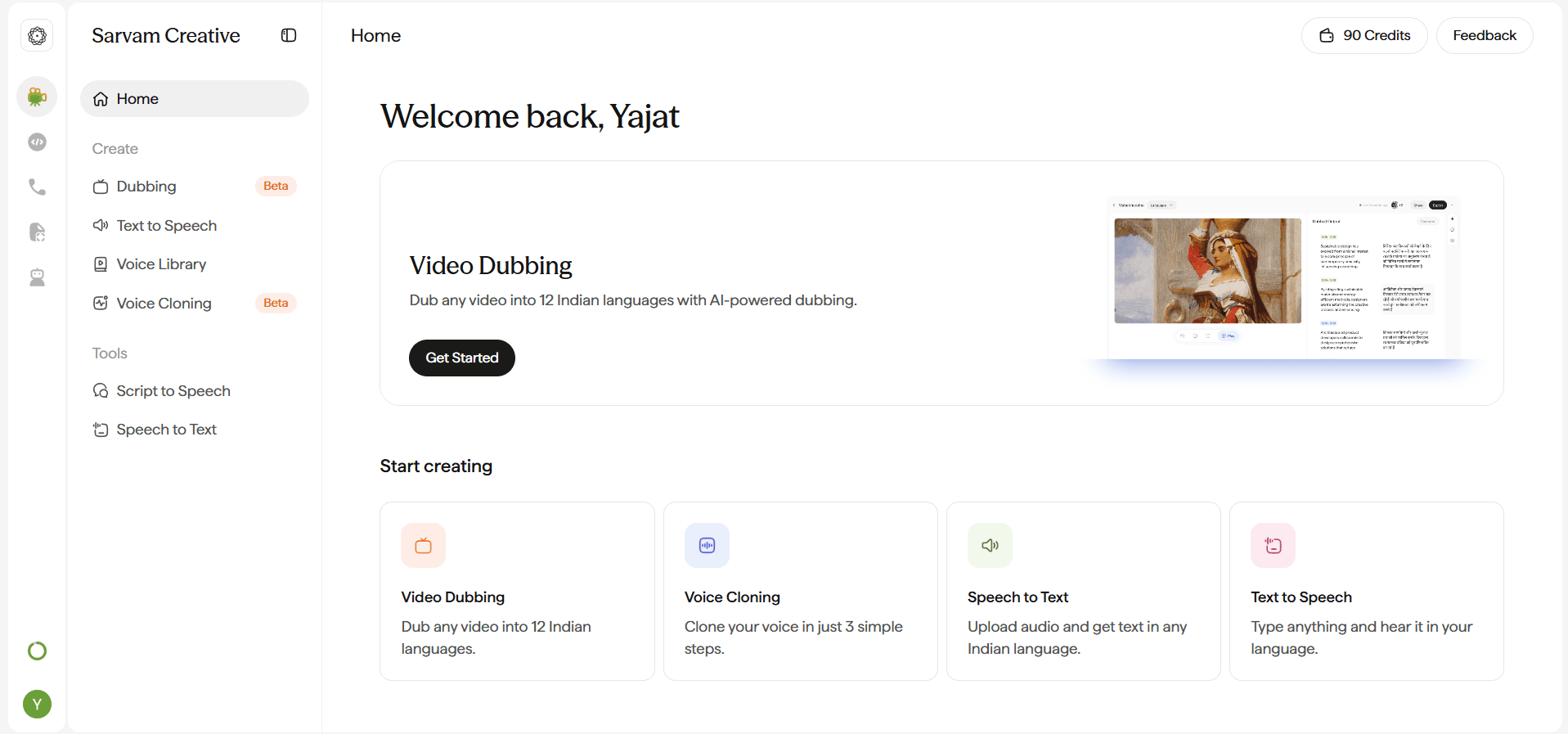
Sarvam owns its full pipeline. Saaras v3 handles speech recognition, covering all 22 scheduled Indian languages plus English. Bulbul v3 handles synthesis, covering 11 Indian languages. Sarvam-105B is the reasoning model behind both: 106 billion parameters, mixture-of-experts, a 128K-token context window, released under Apache 2.0 with weights on Hugging Face. On top sits Samvaad: channel deployment, a "Genie" assistant that builds agents through conversation, and a rate card on the site.
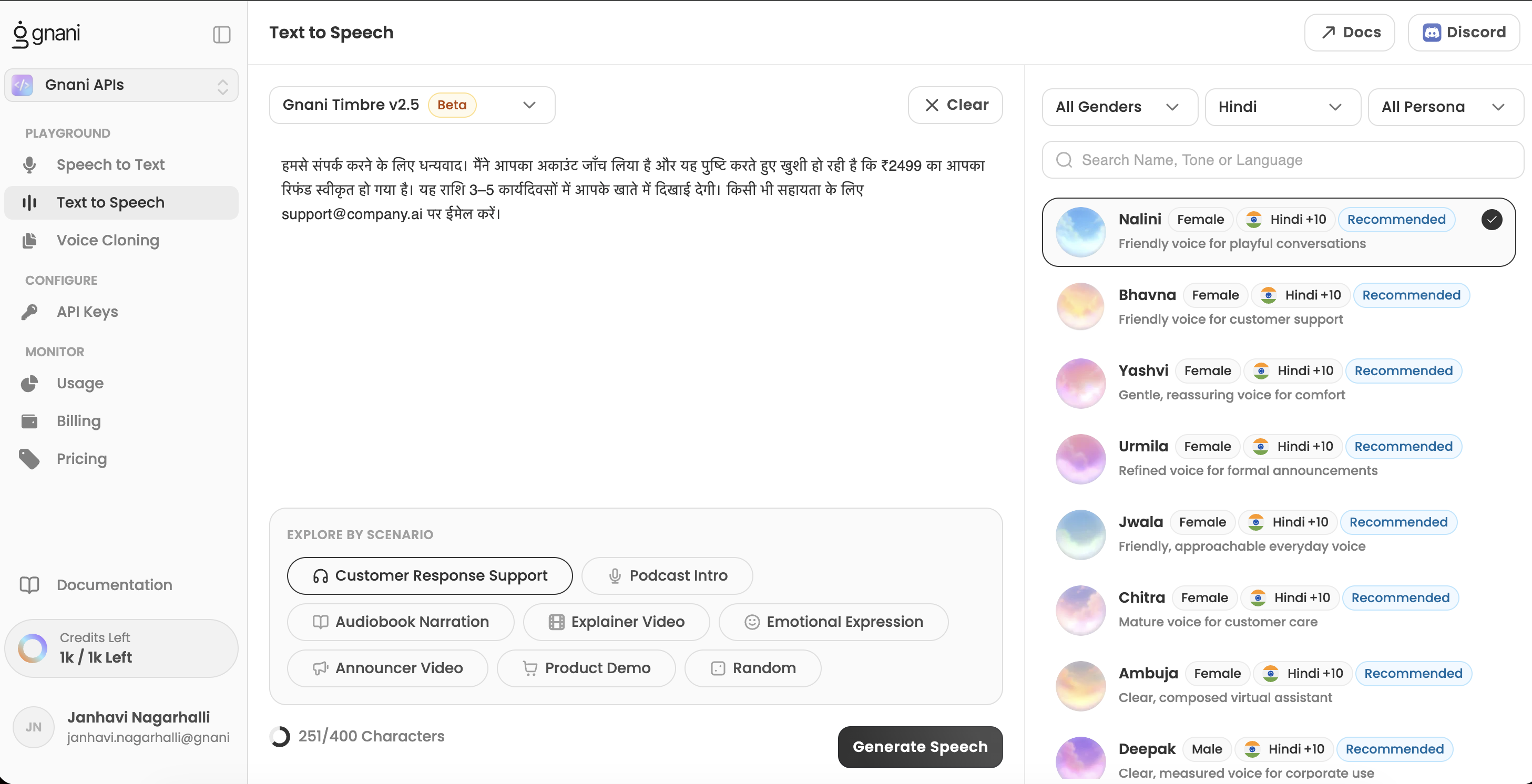
Gnani builds its own models too. The line-up covers speech recognition (Prisma v2.5), text-to-speech (Timbre v2.5), native speech-to-speech (Warp v2.0), and two reasoning models (Evon v2.0 and the open-weight Evon v3.3). On top sit four products: Agents for automated conversations, Analytics for conversation intelligence and QA, Biometrics for voice-based caller authentication, and Assist, which guides a human agent through a live call. Gnani says the platform carries 30 million or more voice interactions a day across 200 or more enterprises, spanning cloud, private cloud, on-premise and air-gapped deployment.
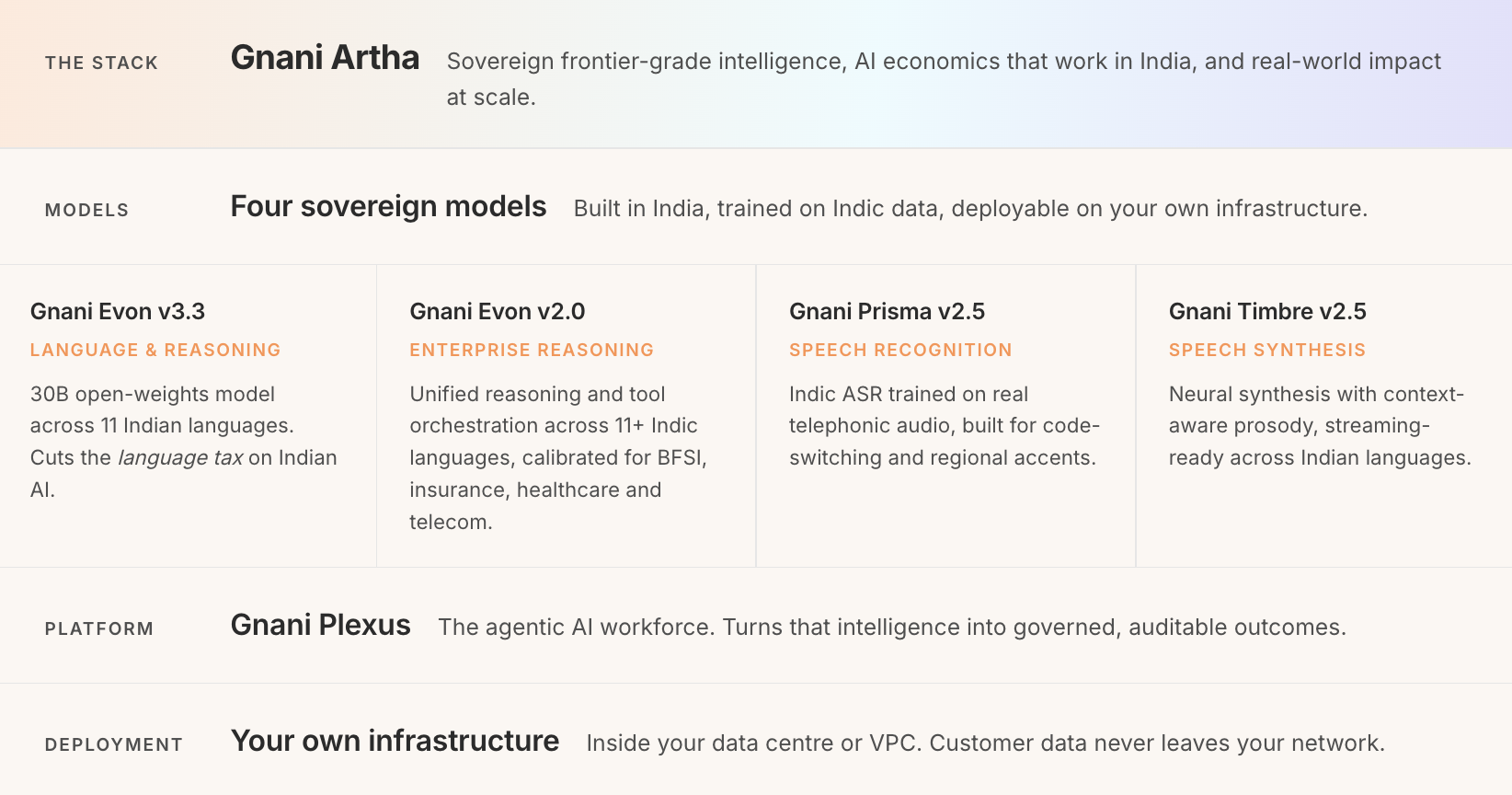
In August 2026 Gnani launched Artha, a sovereign AI stack packaging the Evon, Prisma and Timbre models with Plexus, an orchestration layer, built to run inside a customer's own data centre or VPC.
At a Glance
Feature-by-Feature Comparison
Model ownership: two in-house stacks, different depth
Training your own models end to end is still rare, and both companies do it. Gnani trained Prisma v2.5 on more than 14 million hours of real telephone audio; Sarvam trained Saaras v3 on more than 1 million hours of real Indian audio. On reasoning, Gnani tunes Evon v2.0 for BFSI, insurance, healthcare and telecom, while Sarvam-105B ships a variant built for real-time dialogue, alongside a general-purpose one.
Neither bolts a third-party frontier model onto its pipeline, the more common shortcut here. What separates them is training-data scale and benchmark position, not whether they built or bought.
Verdict: Close call, with a slight edge to Gnani on training-data scale. Sarvam training and open-sourcing its own 106B reasoning model is a real, checkable commitment to owning the full stack.
Indic language and code-switching depth
Gnani lists 10 languages in its recognition layer (English, Hindi, Bengali, Kannada, Gujarati, Punjabi, Marathi, Telugu, Tamil and Malayalam), with 40 or more across the model portfolio. It claims a word error rate under 4%, 96% code-switch accuracy, and first place in 8 of 9 languages on the Kathbath Noisy 8kHz benchmark, the closest public stand-in for real telephony conditions.
Sarvam's Saaras v3 covers all 22 scheduled Indian languages plus English, the wider claim of the two. Sarvam reports a 19.31% word error rate on IndicVoices across 10 languages, down from roughly 22%, and says Saaras v3 beats GPT-4o Transcribe, Gemini 3 Pro, Deepgram Nova3 and Scribe v2 on Indian-language accuracy.
The two test against different datasets, so the numbers don't compare directly, and neither has run an audited WER on your own recordings.
Verdict: Sarvam covers more official languages on paper. Gnani claims the stronger score on noisy 8kHz telephony audio, the condition a call centre actually runs on. Test both before you pick a side.
Latency and real-time performance
Gnani gives latency per layer: Prisma v2.5 streams under 200ms, Timbre v2.5 reports under 100ms time-to-first-audio, and Warp v2.0, the native speech-to-speech model, reports under 200ms at P95. One model instead of three avoids the delay that stacks up as recognition, reasoning and synthesis each take their turn. Gnani Agents report under 800ms response time.
Sarvam reports under 150ms time-to-first-token in Fast mode for Saaras v3, under 250ms median ASR latency, and under 250ms streaming latency for Bulbul v3. Samvaad reports under 500ms real-time latency at the product level.
On scale, Gnani cites 35,000 or more simultaneous streams and 30 million or more voice interactions a day. Sarvam cites 100 million or more minutes transcribed monthly, and 350 million or more conversations on Samvaad, with no stated time window.
Verdict: Both report fast per-layer latency. Gnani's native speech-to-speech model skips a step that Sarvam's pipeline, built from separate models of its own, still has to run. Test both against your own telephony path.
Deployment flexibility and compliance
Gnani supports cloud, private cloud, on-premise and air-gapped deployment, and lists SOC 2 Type 2, ISO 27001, HIPAA, GDPR and PCI-DSS certifications. Artha goes further: the reasoning model itself, not just the infrastructure around it, runs inside the customer's own network.
Sarvam offers VPC and on-premise deployment for its speech APIs, with all processing kept inside India and no cross-border transfer. Its Samvaad page doesn't repeat that claim for the agent platform itself. Sarvam lists SOC 2 Type II, ISO 27001 and DPDP compliance; we found no HIPAA, GDPR or PCI-DSS claim on its pages.
Verdict: Gnani wins on deployment options and certification breadth. If on-premise matters to you, ask Sarvam directly whether it covers Samvaad itself, not only the speech APIs underneath it.
Platform breadth beyond the agent
Gnani ships four products on one platform. Biometrics authenticates a caller from voice alone in under five seconds, drawing on 300-plus voice features per call, with anti-spoof and deepfake detection and cross-lingual enrolment. Assist sits alongside a human agent on a live call, surfacing knowledge in real time and scoring the call automatically. Analytics runs sentiment analysis and compliance checks as the call happens.
Sarvam's Samvaad covers agent-building and orchestration: routing by intent and outcome, calling APIs mid-conversation, and detailed analytics with transcripts and evaluations. Voice biometrics and a live agent-assist tool aren't part of Sarvam's published line-up.
Verdict: Gnani wins here. Biometrics and live agent assist are Gnani's own products with no published Sarvam equivalent, which counts most where sensitive information gets disclosed over the phone.
Pricing transparency and time to value
Sarvam lists a rate card: speech-to-text at ₹30/hour (₹45 with diarization) and text-to-speech at ₹3/1,000 characters, pay-as-you-go, with free starting credits and no commitment. Samvaad claims under 5 minutes to go live.
Gnani doesn't list a rate card; sales quotes price per deployment. Gnani claims under 20 minutes to go live over the API.
Verdict: Sarvam wins on pricing transparency and self-serve speed. Gnani wins on how much a single contract covers, though you need a quote to see the number.
Overall Score Breakdown
Where Both Get Tested: Real-World Enterprise Scenarios
BFSI: a private bank building a multilingual collections agent
500,000 delinquent accounts a month, across Hindi, Marathi, Tamil and Bengali speakers who switch languages mid-sentence. Voice data here is customer PII under DPDP, with RBI expectations on top, and the security review wants inference inside the bank's own walls. If that means the reasoning model must run on-premise, Gnani's Artha stack is built for it. If VPC deployment of the speech layer alone satisfies the review, Sarvam's on-premise option is worth testing. Either way, run 200 of your own collections calls and check WER on account numbers before you commit.
Healthcare: a hospital chain running outpatient engagement
Appointment reminders and follow-ups at volume, where some calls disclose lab results and prescription details. That disclosure makes caller authentication the deciding factor: Gnani's own Biometrics product and HIPAA certification cover this directly. Sarvam has no published HIPAA claim or voice authentication product, so disclosing protected health information would mean bringing in a separate vendor.
Retail and telecom: high-volume self-service at peak load
Order tracking, billing queries and plan changes, at a scale where concurrency spikes several times over baseline during festive season or a network outage. Gnani's 35,000-stream ceiling and native speech-to-speech model give more headroom at that peak. Sarvam's 100 million or more minutes transcribed monthly shows real ASR volume; ask directly for Samvaad's own concurrency ceiling, since its page doesn't give one.
Lock-In and Data Portability
One question gets skipped more than any other, so put it to both vendors directly: if the model underneath your agent gets updated, does behaviour change on a live process without warning, or can you pin a version until you're ready to re-certify? Neither company publishes a versioning or change-notification policy. Put it in the RFP, especially where a script has already cleared compliance review.
Open weights change things for the reasoning layer specifically. Sarvam-105B and Gnani's Evon v3.3 both carry an Apache 2.0 licence with weights on Hugging Face, a self-hosting option outside either vendor's own infrastructure, a real step up from a reasoning layer that only lives behind someone else's API. Still confirm how weights already obtained are treated if the relationship ends, and whether that portability reaches the speech models, since neither offers those as open weights.
Ask both vendors, in writing: can you export transcripts, agent configurations and analytics history; can you export enrolled voiceprints or must they be re-enrolled; and what notice comes before a model change reaches production.
How to Choose Between Gnani and Sarvam
Questions to Ask Before Choosing Gnani or Sarvam
- What is the end-to-end latency from my telephony carrier, not model latency measured inside the vendor's environment?
- What is the word error rate on my own recordings, in my own languages, on 8kHz audio with real background noise?
- Which certifications apply to the exact product I'm buying, not just the company as a whole?
- What is the committed concurrency ceiling, and what happens operationally when I exceed it?
Final Verdict
Which platform wins depends on which of our two weightings matches your situation. Enterprise buyers land on Gnani, 83 against Sarvam's 75, on deployment reach, certification breadth, and biometrics and live agent assist bundled into one contract. Developers land on Sarvam, 80 against Gnani's 75, on visible pricing and an API you can start using today without a sales call.
Whichever way you lean, test both against real recordings from your own environment, in your own languages, at your own peak concurrency, before you sign anything.
Frequently Asked Questions
What's the difference between Gnani and Sarvam?
Both train their own speech and reasoning models instead of licensing someone else's. Gnani sells voice biometrics, live agent assist, conversation analytics and orchestration alongside its agents, with on-premise and air-gapped deployment. Sarvam lists a rate card, offers self-serve onboarding, and has released its reasoning model, Sarvam-105B, as open weights.
Is Sarvam AI open source?
Not the platform as a whole, Sarvam's hosted APIs and Samvaad are paid, metered services. What's open is the reasoning model underneath: Sarvam-105B is freely downloadable from Hugging Face. Gnani's Evon v3.3 is open-weight too, but gated "by request" through Artha, not a direct download.
How much does Sarvam cost, and why doesn't Gnani publish pricing?
Sarvam lists rupee rates starting at ₹30 per hour of transcribed audio, so the entry cost is known upfront. Gnani quotes per deployment through sales instead, because its contract bundles in voice authentication and quality assurance that a model-only deployment would need to source from a separate vendor. Compare total workflow cost, not just the per-minute rate.
Is Gnani only built for large enterprises, or can a startup use it too?
Mostly the former today. Gnani's pricing, four-product bundle and certification set are scoped for regulated, high-volume deployments, and it doesn't publish a self-serve rate card. A startup or small team without compliance or on-premise requirements will move faster and cheaper starting with Sarvam's public pricing and self-serve Samvaad setup. Gnani becomes the better fit once compliance, on-premise deployment, or voice authentication enter the picture.
Which platform is better for a developer building a voice bot on their own?
Sarvam, for most solo builds: a documented API and an open-weight model (Sarvam-105B) you can call or self-host directly, no sales conversation required. Gnani's products are sold as a single enterprise contract with no public sandbox, harder to start building on alone.
Which platform supports more Indian languages?
Sarvam's Saaras v3 covers all 22 scheduled Indian languages plus English. Gnani lists 10 in its own recognition layer, with 40 or more across the model portfolio. The two count coverage differently, so check the list against your own deployment languages before deciding.
Does Gnani or Sarvam support on-premise deployment?
Both do, to different degrees. Sarvam's on-premise option covers its speech APIs; that isn't confirmed for Samvaad itself. Gnani supports on-premise and air-gapped across its whole platform, extended to the reasoning model itself through Artha.
Which platform is better for BFSI or healthcare voice AI in India?
For a regulated deployment needing the reasoning model inside the customer's own network, voice authentication before disclosure, and HIPAA certification, Gnani covers more of that today, Sarvam's published compliance set stops at SOC 2, ISO 27001 and DPDP.
Does Gnani offer voice biometrics for caller authentication?
Yes. Gnani builds voice biometrics in-house: verification under five seconds, 300-plus voice features per call, anti-spoof and deepfake detection. Sarvam has no biometrics product in its line-up, so voice authentication would need a separate vendor.
Can I switch between Gnani and Sarvam later without losing my agent setup?
Not cleanly today. Neither company publishes an export or version-pinning policy, get specific commitments in writing before you sign, especially where a live script has already cleared compliance review.
Which platform has lower latency for real-time voice agents?
Both report fast numbers, but not the same thing. Gnani's Warp v2.0 reports under 200ms at P95; Samvaad reports under 500ms end to end. The two aren't measuring identical pipelines, so test both against your own telephony path rather than comparing the published numbers directly.
