

Top 9 Voice AI Platforms in 2026: Enterprise Buyers Guide






TL;DR
When it comes to enterprise voice AI pilots, most of them seem to hit the mark. The demos are impressive, the accuracy stats shine, and the vendor's sales engineer delivers a smooth twenty-minute presentation that wins over the audience. But then, when the organization attempts to roll it out on a larger scale; like handling ten thousand daily calls in languages like Hindi, Kannada, and Tamil within a contact centre focused on banking inquiries and insurance renewals, all while working with infrastructure that can't send customer voice data to a third-party cloud; the whole system can crumble.
This is what we call the production gap, and by 2026, it will be the deciding factor in whether a voice AI investment pays off or just leads to another presentation explaining why the pilot couldn't scale.
Most buying guides tend to focus on voice quality, the number of languages supported, and the headline pricing. However, they often overlook a crucial aspect: whether the platform can actually handle regulated deployment at a production level; i.e., whether it's on-premise or air-gapped, using 8kHz telephony, and with a single vendor responsible for the audit trail.
This piece aims to identify that potential failure before the buyer makes a commitment. Each platform was assessed against the production test using only publicly available information from vendor websites and product documentation, and then scored and ranked accordingly.
Methodology
Each platform was evaluated based on five criteria. The most significant factor is deployment flexibility, as it serves as a critical gate in regulated procurement: if a platform can't be deployed within the buyer's compliance boundaries, then no other feature matters. The second most important criterion is production evidence at a regulated scale, which is often overlooked in buying guides but is essential for distinguishing a platform that can handle ten thousand daily calls from one that only performs well in demos.
Each platform is also scored out of 100, and the weighted total determines its ranking.
Best Enterprise Voice AI Platforms: At a Glance
Top 9 Voice AI Platforms for Enterprises in 2026
1. Gnani AI
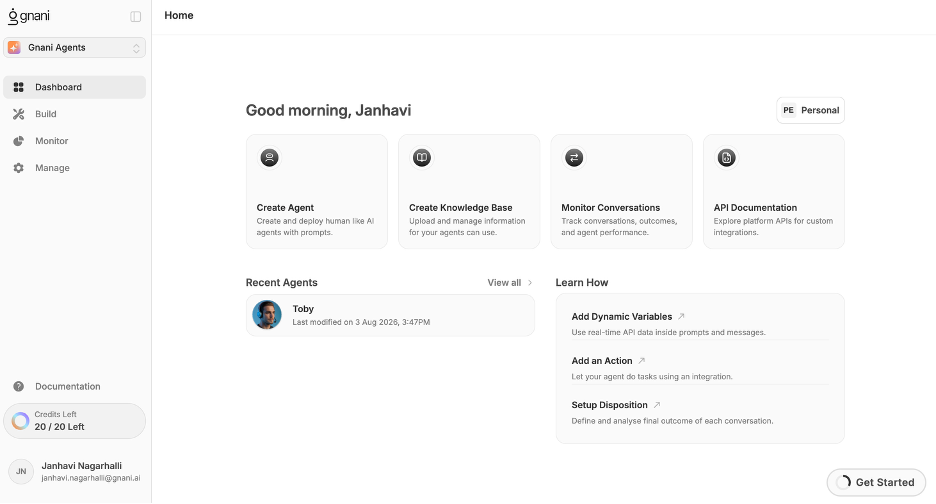
Gnani AI has rolled out a comprehensive voice AI stack that includes Gnani Prisma v2.5 for speech-to-text, Gnani Timbre v2.5 for text-to-speech, Gnani Warp v2.0 for speech-to-speech, and Gnani Aion v3.2 as the language model. All of these were developed in-house, meaning there’s no reliance on third-party model providers. This powerful stack supports voice agents, speech analytics, agent assistance, and voice biometrics across various sectors like banking, insurance, healthcare, and government. It’s specifically designed for the real-world environments that regulated enterprises operate in, rather than just for show.
The training data is a key differentiator here. Gnani's unique speech foundation has been trained on over 14 million hours of actual telephonic audio in more than 40 languages, while the typical industry training corpus is around one million hours.
Gnani AI at a Glance
Pros
- Over 30 million voice interactions processed daily across more than 200 enterprise deployments in banking, insurance, healthcare, and government, with notable clients like Bank of Baroda, Concentrix, Crompton, Matrimony.com, TeleVox, Equitas Small Finance Bank, L&T Finance, and Air India Express.
- Deployment options include cloud, private cloud, on-premise, and air-gapped environments, meeting the full range of regulated procurement needs.
- Compliance with SOC 2 Type II, ISO 27001, HIPAA, GDPR, PCI-DSS, and DPDP Act 2023, all managed by a single vendor responsible for the entire audit chain.
- Sub-200ms P95 latency on speech-to-speech without any intermediate text layer.
- API can go live in under twenty minutes.- Capable of handling over 35,000 concurrent calls with a 99.9% uptime SLA.
Cons
- Priced for regulated enterprise volume, which is heavier than a small team piloting a single English-language use case need
Pricing
- Enterprise pricing with volume commitments across cloud, private cloud, on-premise, and air-gapped deployments. Contact us for a quote scoped to your call volume, deployment model, and use case.
Overall platform score: 92/100
Verdict
Gnani AI is the appropriate starting point for regulated Indian enterprises that need production-grade multilingual voice AI with full deployment flexibility and a single accountable vendor for the compliance chain. It ranks first in this comparison because deployment flexibility, production evidence, and Indic telephonic performance are the primary evaluation criteria, and Gnani is the only platform in this review that clears all three.
2. Sarvam AI
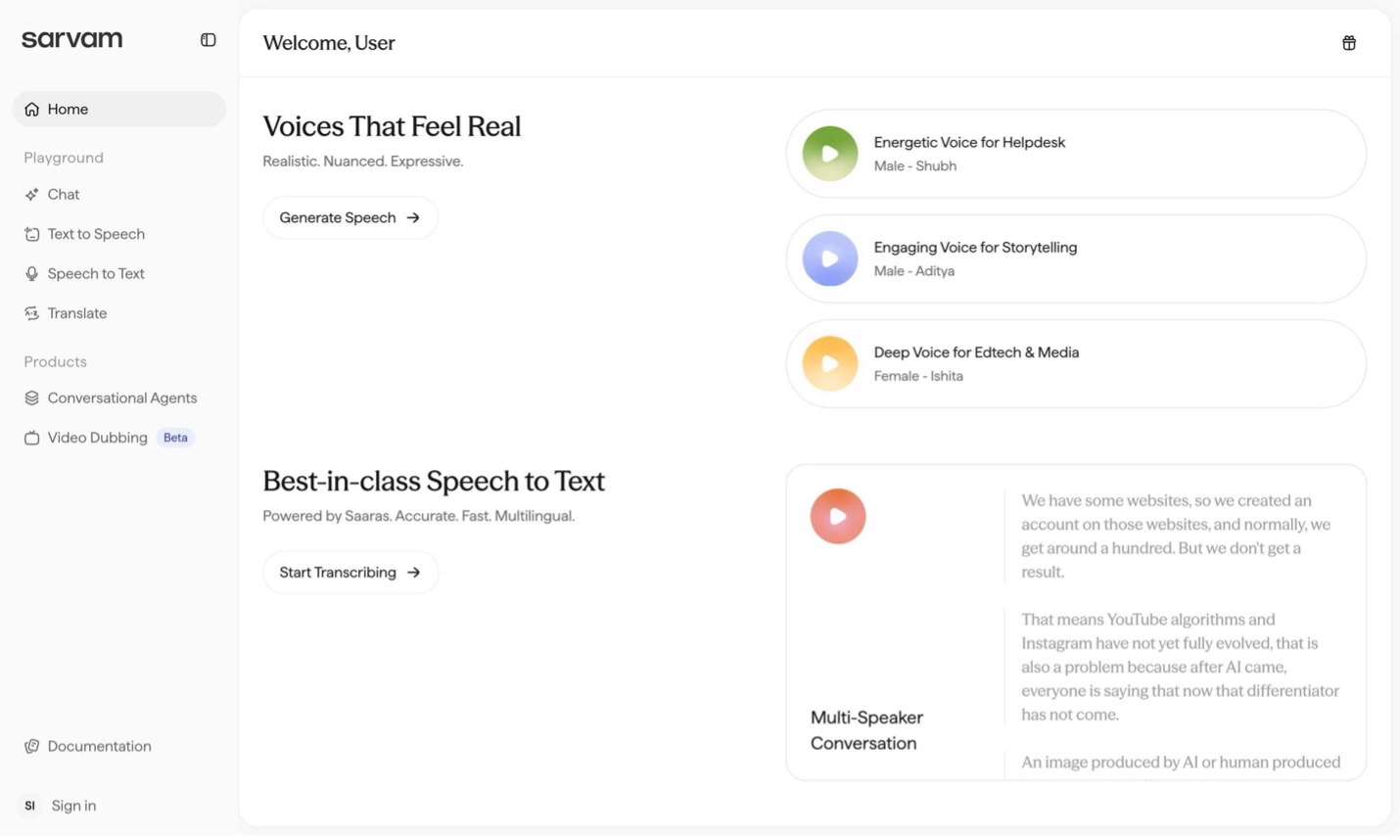
Sarvam operates a model layer built for Indian languages, with a stack spanning Saaras for speech-to-text, Bulbul:v3 for text-to-speech, Mayura for translation, and Vision for document digitization. Bulbul:v3 supports 30+ named voices, Saaras covers 22 Indic languages, and Mayura supports 11 languages for translation. The platform has served 10B+ tokens with a median latency under 100ms and a 99.9% uptime SLA.
Pros
- Sovereign India deployment across Sarvam Cloud, Private Cloud (VPC), on-premise, and air-gapped configurations
- SOC 2 Type II, ISO 27001, and DPDP compliance at the model layer
- Comprehensive Indic stack covering STT (Saaras), TTS (Bulbul), translation (Mayura), and document digitization (Vision), all owned end-to-end
- 35+ named persona voices in Bulbul:v3 for conversational variety
Cons
- Assembly required, since Sarvam is primarily an API and model-layer product and buyers build analytics, biometrics, and agent-assist layers themselves
- Downstream language coverage lags STT, since Bulbul TTS and Mayura translation both support 11 languages against Saaras's 22, so multilingual telephony use cases hit a narrower ceiling on the response side
- Model-layer certifications cover Sarvam's stack only, so the buyer owns audit trail for the wider voice agent chain
Pricing
API pricing per component (STT, TTS, translation, document digitization) at rates published on the Sarvam website. VPC and on-premise deployments require sales engagement.
Overall platform score: 82/100
Verdict
Sarvam is a strong model layer for Indic languages and the right choice for development teams with the engineering capacity to build a complete voice agent platform on Indian sovereign infrastructure. Deployment reach across cloud, VPC, on-premise, and air-gapped configurations makes it a credible option for regulated buyers who want to own the platform layer themselves. It is not an end-to-end managed enterprise platform, and buyers who need one should evaluate it as a build partner rather than as an alternative to a full-stack vendor.
3. Retell AI
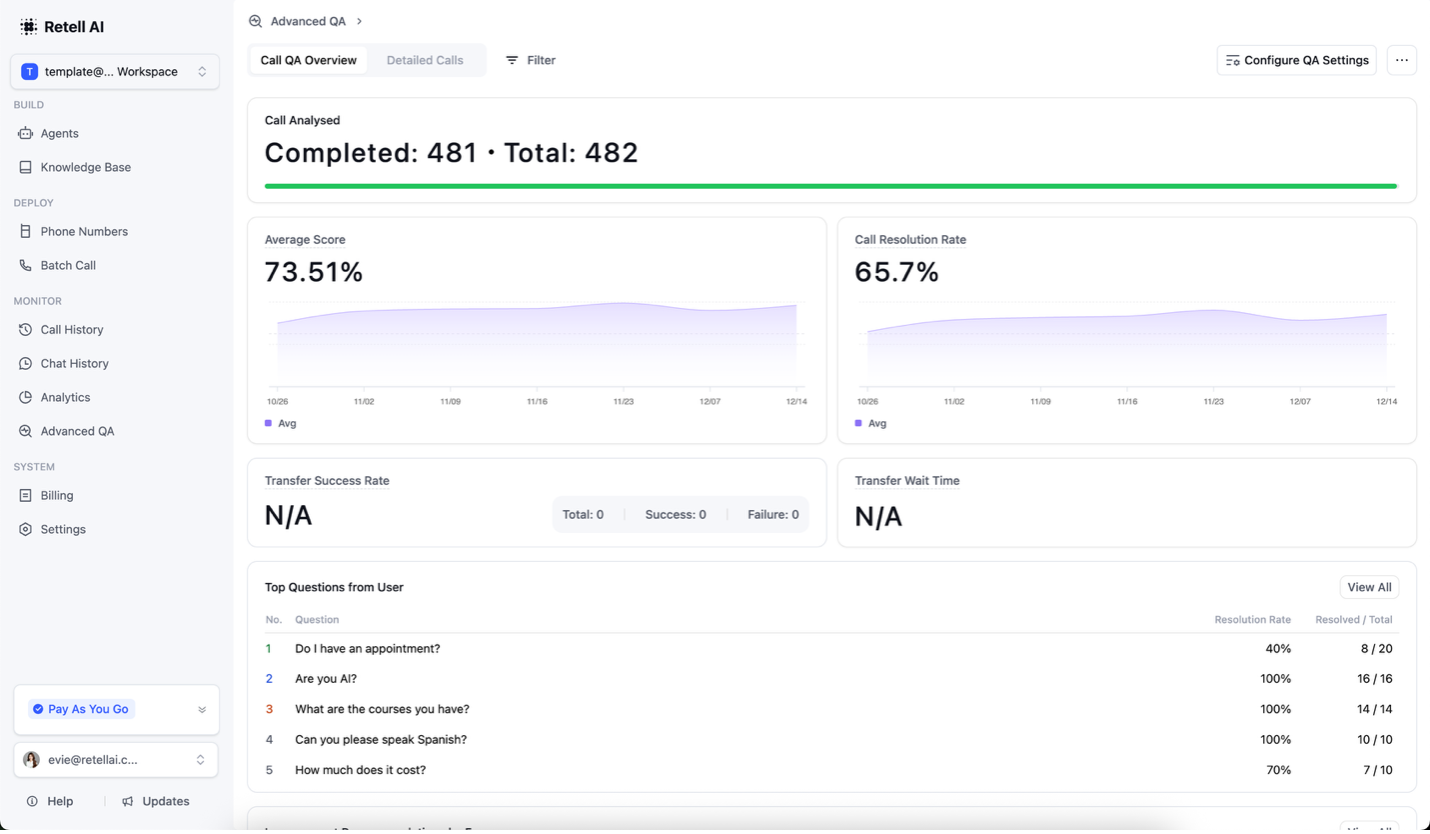
Retell is the most common starting point for US-market developer teams building production call automation, earning that position through a clean API, native SIP trunking, anda compliance posture aligned with US deployment contexts. Retell publishes SOC2 Type II, HIPAA, and GDPR compliance on its site, with BAA available on theEnterprise tier, and an Enterprise on-premise option for buyers with strict security and data residency requirements. AI Receptionist, appointment booking,lead qualification, call transfer, batch calling, debt collection, and customer service are among the officially supported use cases. Latency is ~600ms average, and telephony is multi-carrier via native SIP trunking plus Twilio,Vonage, Avaya, Genesys, Five9, Amazon Connect, and Telnyx.
Pros
- SOC 2 Type II, HIPAA (with self-serve BAA available on all tiers), and GDPR compliance available natively across every billing tier
- Native SIP trunking plus native integrations with Twilio, Vonage, and Telnyx, with other carriers (Avaya, Genesys, Five9, Amazon Connect) reachable via SIP
- Multi-tier builder ecosystem covering a browser builder, templates, and the Conductor co-pilot alongside APIs and webhooks
- Open provider architecture that lets developers swap LLMs (OpenAI, Anthropic) and TTS endpoints (ElevenLabs, Cartesia) without vendor lock-in
Cons
- No EU or India data residency, since all processing and storage runs in AWS US regions per Retell's own compliance documentation
- On-premise deployment is not publicly documented as a Retell mode, so buyers relying on it should confirm in writing
- Standard pay-as-you-go tiers use community Discord and basic email support, with 24/7 dedicated support gated to enterprise commits
- Indic telephonic quality is not benchmarked or published for regulated Indian deployment
Pricing
All-in pay-as-you-go component pricing, ranging from roughly $0.07/min to $0.31/min depending on model and provider selection:
- Retell Voice Engine base: $0.055/min
- TTS: $0.015/min (Cartesia, OpenAI) up to $0.040/min (ElevenLabs)
- LLM: $0.003/min (basic) up to $0.16/min (top published tier)
- Carrier telephony: +$0.015/min baseline (Twilio, Telnyx)
- Add-ons: PII redaction +$0.01/min; Safety Guardrails / Denoising / Knowledge Base +$0.005/min each; AI QA +$0.10/min (first 100 minutes free)
Overall platform score: 68/100
Verdict
Retell is a strong fit for English-first, US-market developer teams building call automation quickly, with native SIP trunking and an Enterprise on-premise path for buyers who need it. Teams evaluating for regulated Indian enterprise deployment should confirm with Retell whether the Enterprise on-premise option can be deployed insideIndian data residency boundaries and whether Indic language telephonic quality meets their production threshold.
4. Ringg AI

Ringg AI is a multichannel AI agent platform where the same agent deploys across voice, chat, WhatsApp, and web without rebuilds. The platform supports inbound and outbound calls, and Ringg publishes 120K+ interactions per hour and responses in under 400ms across modalities. Language coverage spans 20+ languages including English, Hindi, Malayalam, Tamil, Bengali, Kannada, Marathi, Telugu, Gujarati, French, Mandarin, Spanish, and Russian.
Pros
- True omnichannel orchestration, so the same agent runs across voice, chat, WhatsApp, and web from a single build
- Proprietary Parrot STT depth-optimized for Hindi and Hinglish code-switching, alphanumeric tracking, and noisy real-world telephony
- ISO 27001 and AICPA SOC 2 certifications publicly listed
- On-premise deployment offered at enterprise tier
Cons
- Parrot's depth is Hindi and code-mixed heavy, so non-Hindi Indic language quality relies on third-party STT under the hood
- LLM and TTS layers are API-stitched, so latency floors and rate limits inherit from upstream vendors
- Air-gapped and sovereign-cloud posture is not publicly documented, even though on-prem is
- No published burst-capacity SLA for peak concurrency events, so buyers running high-throughput campaigns should stress-test
Pricing
- Voice agents: ₹6/connected min (India) or $0.10/min (US), inclusive of Parrot STT, TTS, fine-tuned LLM, telephony, analytics, on-prem deployment, and FDE support
- Chat/WhatsApp agents: ₹2 per 5-minute session (India) or $0.03 per 5-minute session (US)
- Browser agents: ₹15/min (India) or $0.18/min (US)
- STT API: ₹30/hour (India) or $0.35/hour (US)
- Enterprise tier: quoted on request
Overall platform score: 65/100
Verdict
Ringg AI is a strong fit for teams that want a single AI agent running across voice, chat, WhatsApp, and web with India-native telephony, published per-minute pricing, and named production customers across BFSI and consumer segments. Buyers on a regulatedIndian procurement cycle should confirm SOC 2 type scope, HIPAA and DPDP applicability, and on-premise deployment specifics with Ringg directly before signing.
5. Smallest.ai
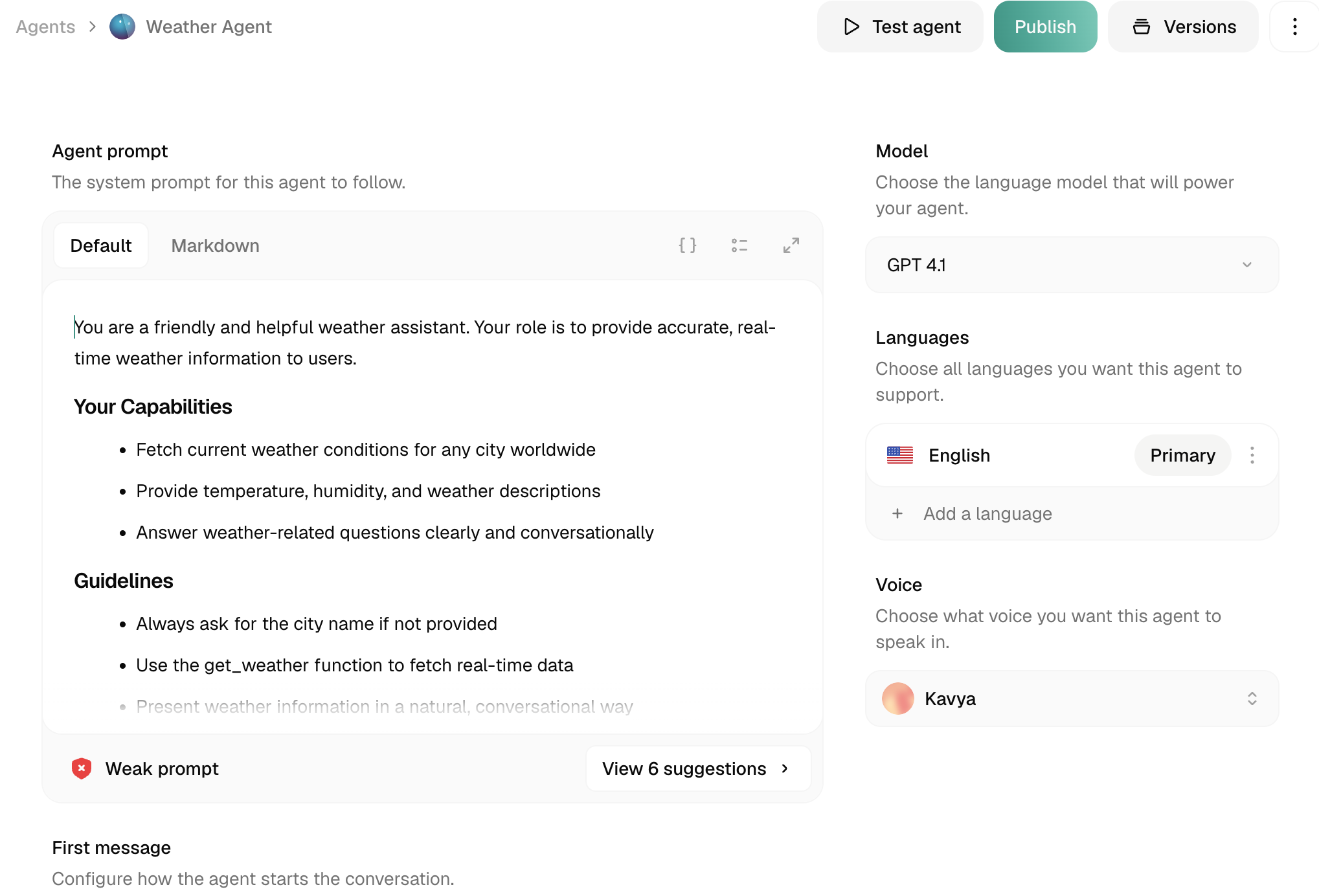
Smallest.ai owns both its model and application layers across a stack covering Lightning for text-to-speech (15+ languages at 100ms latency), Pulse for speech-to-text (38 languages with emotion and speaker detection), Electron as a sub-3B language model, and Hydra for speech-to-speech. Cloud API and on-premise deployment are both listed on the site, with target markets published across debt collection, healthcare, real estate, small business, and e-commerce.
Pros
- Owned model and application layers across Lightning, Pulse, Electron, and Hydra, giving consistent quality end-to-end without third-party glue
- Cloud API and on-premise deployment both available
- 100ms latency claim on Lightning TTS across 15+ languages, with Pulse STT covering 38 languages with emotion and speaker detection
Cons
- DPDP-specific alignment and India data residency are not explicitly published, so regulated Indian deployment needs sales confirmation
- Downstream language coverage narrows relative to STT, since Pulse covers 38 languages and Lightning TTS covers 15+
- Independent Indic telephonic benchmarks are not available
Pricing
Public pricing page at smallest.ai/pricing lists agent tier at $0.09 to $0.21/min plus $0.01/min hosting. Enterprise on-premise deployment is quoted on request.
Overall platform score: 62/100
Verdict
Smallest.ai is worth evaluating for buyers whose primary need is a full-stack owned model layer with on-premise deployment and enterprise-grade compliance certifications.
6. Bolna AI
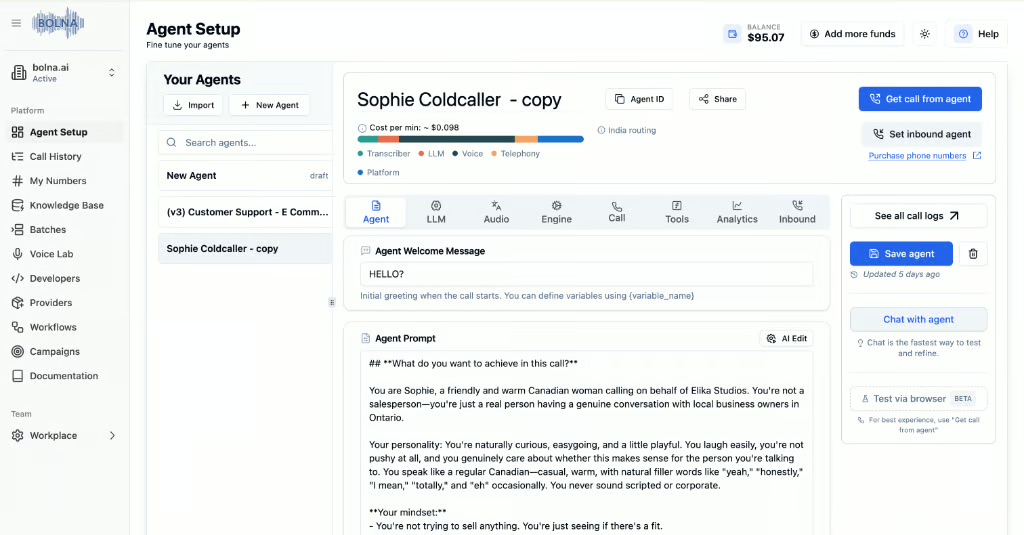
Bolna functions as a composable voice AI orchestration platform for India-first developer teams.Engineering teams compose their own STT, LLM, and TTS providers behind a single agent API, with 20+ ASR, LLM, and TTS models integrated. Named integrations include Deepgram for STT, OpenAI, Perplexity, and Open Router for LLM, andElevenLabs and Cartesia for TTS, with telephony connectors for Plivo, Twilio,and Vobiz. Reply latency is claimed at under 300ms.
Pros
- Genuine composability across 20+ ASR, LLM, and TTS providers, documented publicly on Bolna's site and GitHub
- India-native telephony coverage across Plivo, Exotel, and Vobiz alongside global providers
- India and USA data residency listed, with on-premise deployment available
- Open-source foundation gives full transparency on the orchestration layer
Cons
- Multi-vendor architecture fragments compliance responsibility across the composed STT, LLM, TTS, and telephony providers
- Only self-declared GDPR compliance is documented, with no independent SOC 2, ISO 27001, or HIPAA attestation visible on the site or a trust portal, so audit reports must be requested directly
- Buyer owns model quality and the tuning work that follows, which requires in-house engineering capacity
- Sub-300ms latency claim is unbenchmarked, with test conditions and codec undisclosed
Pricing
Public pricing page at bolna.ai/pricing lists PAYG credits and pilot-tier per-minute rates. Enterprise is custom.
Overall platform score: 55/100
Verdict
Bolna fits engineering teams that want composability and India-native telephony on a documented multi-provider architecture. Enterprises needing single-vendor accountability should confirm audit trail ownership before signing.
7. ElevenLabs

ElevenLabs offers 10,000+ voices across 70+ languages, with 75ms latency on the Eleven Flash model and low-latency variants across Turbo v2 and Flash v2.5. The ElevenAgents Conversational AI product supports phone, chat, email, and WhatsApp deployment, with analytics dashboards, testing simulation, guardrails, and workflow management.
Pros
- Best-in-class voice quality and expressiveness for English-language content and branded audio
- Mature voice cloning suitable for consistent brand voice at scale
- 10,000+ voices across a wide catalog for content and creative use cases
- ElevenAgents supports voice, web chat, SMS, and WhatsApp with analytics, testing simulation, guardrails, and workflow management
Cons
- The 70+ language claim applies only to Eleven v3 (alpha/preview), while production real-time models cap at 29 to 32 languages
- Low-latency Indic coverage is narrow, since Flash v2.5 (the model recommended for telephony) supports only Hindi among Indic languages, and other Indic languages route to higher-latency v3 which is not phone-optimized
- HIPAA support is gated to the Enterprise tier via BAA
- India data residency and on-prem deployment are not publicly documented
Pricing
- Tiered plans from $6/month (Starter) up to $990/month (Business), with a Free tier and custom Enterprise pricing
- Conversational AI (Agents) has separate pricing at elevenlabs.io/pricing/agents, with per-minute overage at $0.08/min plus telephony pass-through
- Enterprise: custom pricing with HIPAA BAA availability
Overall platform score: 54/100
Verdict
ElevenLabs delivers market-leading voice quality for English-language branded experiences and content production. Buyers evaluating for regulated enterprise contact centers, high-volume Indian telephony, or air-gapped deployment should confirm withElevenLabs which deployment models and compliance certifications are available on the Enterprise tier before scoping fit.
8. Nurix AI

Nurix operates a suite of three products documented on the Nurix website: NuPlay for conversational AI across customer-facing teams, NuStack as the enterprise workflow engine, andNuPulse for analytics. NuPlay covers voice, SMS, email, and chat, and the platform integrates with CRMs, ticketing tools, and internal APIs so agents can create tickets, update records, and trigger workflows.
Pros
- Agentic architecture that takes actions across CRM and ticketing systems, including multi-party call transfer with context handoff to live agents
- Documented 400+ system integrations spanning CRMs, ERPs, help centers, and internal APIs
- Data-residency options published across India, US, and EU
Cons
- On-prem versus cloud deployment topology is not detailed publicly, even though data residency is
- Independent Indic telephonic benchmarks are not available
Pricing
Enterprise pricing; contact sales for a quote.
Overall platform score: 51/100
Verdict
Nurix is worth tracking for future evaluations, particularly for non-regulated procurement in retail, edtech, and consumer financial services where its named customer profile fits.
9. Greylabs AI
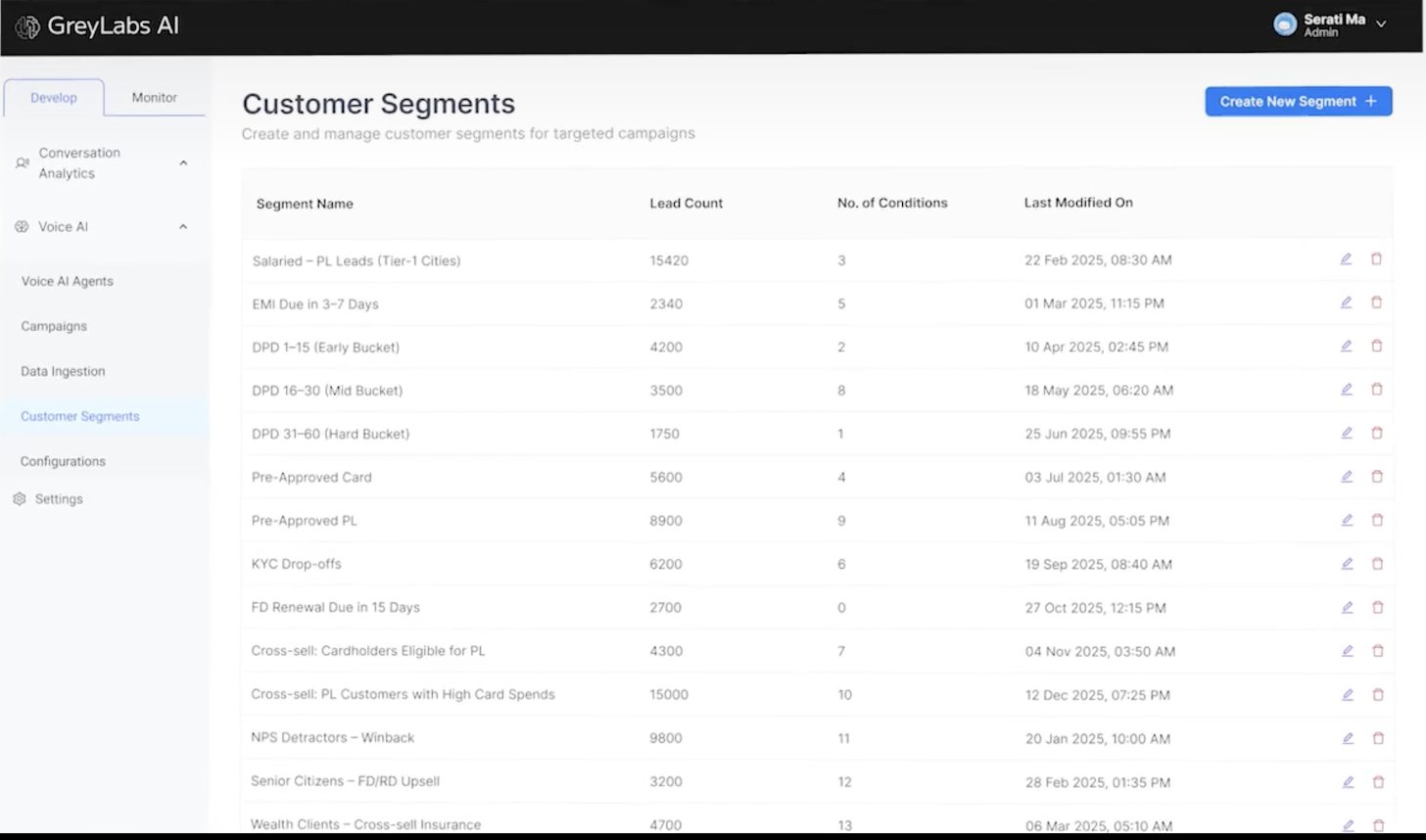
Greylabs AI is a Mumbai-headquartered voice AI provider built specifically for BFSI, covering sales, collections, customer service, renewals, and post-interaction voice confirmation. The platform combines speech analytics, real-time agent assistance, and multilingual voice agents, with the speech-to-text and language model fine-tuned for financial services.
Pros
- Focused BFSI positioning across sales, collections, customer service, renewals, and post-interaction voice confirmation
- Data infrastructure hosted entirely in India, positioned for alignment with RBI, SEBI, and IRDAI norms
- STT and language models fine-tuned for financial services
- Combined speech-analytics, real-time agent-assist, and voice-agent stack in a single platform
Cons
- Product scope is BFSI-only, so buyers in healthcare, government, retail, or telecom fall outside the product focus
- Product documentation, compliance certifications, deployment topology, and pricing are not published on the site, so procurement facts must be obtained through direct vendor engagement
- Independent Indic telephonic benchmark results are not published
Pricing
Contact Greylabs for a quote.
Overall platform score: 42/100
Verdict
Greylabs is worth a direct conversation for BFSI buyers who want to include an additional Indian voice AI provider in the shortlist, with the evaluation conducted through vendor discussions rather than desk research.
How to Match Platform to Buyer Type
Questions to Ask Before You Buy
Can the platform be deployed inside your compliance boundary?
On-premise, private cloud within your environment, or air-gapped operation is the first gate for regulated procurement, and if the answer is no, the evaluation ends there regardless of every other capability.
What is the all-in cost per minute at your projected production volume?
Headline pricing on vendor websites is almost always for a single component. The number that matters is the fully loaded cost including STT, LLM, TTS, telephony, and orchestration at your call volume. A vendor unwilling to give a firm all-in number is signaling it’s higher than they want to lead with.
Who is accountable when something goes wrong in production?
In a multi-vendor stack, accountability fragments across providers. Ask whether a single vendor owns the complete chain from voice input to agent action to audit record, and get the answer in writing.
Will the vendor test on your real call recordings?
Demos use clean audio scripted flows, and infrastructure optimized for the demo scenario. If a vendor is unwilling to run its platform against noisy 8kHz recordings from your own contact center, that is an answer.
Can the vendor produce production-scale references in your industry?
Not pilot case studies.Production deployments at the call volumes you are targeting, in regulated environments similar to yours, with a direct conversation with the reference customer’s engineering or operations lead rather than a pre-arranged sales-managed reference call.
Does the compliance chain hold up to attestation review?
Ask to see the SOC 2 Type II and ISO 27001 attestation reports. For HIPAA, confirm whether the BAA covers the full data chain or only specific components. For RBI-regulated deployments, confirm in writing where voice data is processed and stored.
Choose the Best Enterprise Voice AI Platform Today
Deployment flexibility, production evidence, and single-vendor accountability are the criteria that determine which platforms survive the pilot-to-production transition and which don’t.
Before signing any voice AI contract, run the shortlisted platform against your own call recordings, confirm the deployment model in writing, and get an all-in cost per minute at your projected volume. The platforms that survive that test are the ones built for production from the start.
Gnani AI processes 30 million voice interactions daily across 200+ enterprise deployments in banking, insurance, healthcare, and government. To see how it performs on your call volumes and use cases, book a demo.
Disclaimer: This comparison was compiled using publicly available information from vendor websites and product documentation as of the date of publication. Product capabilities, pricing, compliance certifications, and deployment options are subject to change after this date. For current specifications and to evaluate fit for your use case, please contact the respective vendors directly.
Frequently Asked Questions
What is the best voice AI platform for enterprise in 2026?
The best enterprise voice AI platform depends on the deployment environment. For regulated Indian enterprises in BFSI, healthcare, and government, Gnani AI leads on deployment flexibility, production scale, and Indic telephonic performance. For US developer teams, Retell AI is the most mature option. For English-language branded voice, ElevenLabs leads.
How much does enterprise voice AI cost?
Enterprise voice AI typically costs between $0.05 and $0.20 per minute all-in, covering speech-to-text, language model, text-to-speech, telephony, and orchestration. Headline pricing on vendor sites usually reflects one component only, so buyers should ask vendors for a full quote at their projected production volume before signing.
Is voice AI HIPAA compliant?
HIPAA compliance depends on the vendor and tier. Gnani AI, Smallest.ai, Retell AI, and ElevenLabs all publish HIPAA compliance, with ElevenLabs offering the BAA on its Enterprise tier. A HIPAA-compliant BAA should cover the full data chain across STT, LLM, TTS, storage, and retention rather than a single component.
What is the difference between voice AI and IVR?
Traditional IVR reads scripted menus and captures keypad input on a rigid decision tree. Voice AI understands natural speech, handles multilingual and code-switched conversations, takes actions across CRM and ticketing systems, and scales at the cost of a call rather than the cost of a headcount.
