

Voice AI Agents for Healthcare: Setup and Deployment






TL;DR
A voice agent can run 24 call workflows across a hospital, diagnostics chain or insurer. Sort them by what each needs before it goes live rather than by department.
- Phase 1, live in weeks: Seven inbound workflows covering booking, general enquiry, bed availability, complaints, billing and TPA queries, refill routing and home collection. No consent apparatus, no clinical protocol.
- Phase 2, once consent infrastructure exists: Eleven outbound workflows from reminders and report alerts through pre-authorisation and camp campaigns. Each needs consent capture, DND scrubbing, calling window control and template approval.
- Phase 3, after clinical sign-off: %ive clinical-adjacent workflows including post-discharge check-ins and medication adherence. None launch without a written protocol and a red-flag set.
- Start with appointment booking. Diagnostics networks are the exception and should start with report availability alerts.
- Six things break deployments. Turn latency above 800ms, language detection that collapses on code-switched speech, read-only scheduling access, no written escalation taxonomy, outbound dialling before consent, and a HIPAA posture assumed to cover Indian operations.
- Gnani AI can run all 24 on a stack it owns end to end, across 40+ languages including 12+ Indian languages, which is what keeps turn latency down and makes Indian data residency workable alongside HIPAA-aware workflows.
The case for voice AI in healthcare is arithmetic. Call volume exceeds what the team can answer, hiring is capped by training capacity rather than budget, and every abandoned call leaves an empty slot and a missed follow-up that appears nowhere in the reporting. Automation absorbs the volume no human team can reach.
Healthcare has automated phone calls before, and patients still describe the result as a phone tree. Two decades of IVR taught providers that a system which routes without resolving moves the cost rather than removing it. Most voice AI pilots stall for the same reason, having automated the greeting while leaving the work with a person.
What separates the two is task completion. An AI voice agent understands open speech, does the work inside your HIS or scheduling system, and hands a clinician the conversation when it reaches a boundary it should not cross. That capability holds on high-volume, rules-bounded, low-risk calls where the system can write back, and it breaks outside them. So the useful question is which calls qualify, and in what order you take them on.
At Gnani, we've seen that there can be24 call workflows a voice agent can run across a hospital, diagnostics chain or insurer, and most institutions start with one or two. This page covers all 24, what each one needs before it can go live, where to start by institution type, and the six things that break in production.
How an AI voice agent handles a patient call
Take one workflow. A pathology chain marks a report ready in its LIS, which fires call. The agent confirms the patient against date of birth and the number on file, says the report is available, explains collection and download options, and offers the review consultation. A slot taken on the call is written back to the system with an SMS confirmation. A patient who asks what the result means leaves the automated flow for the medical desk, because the agent never reads out or interprets a result value.
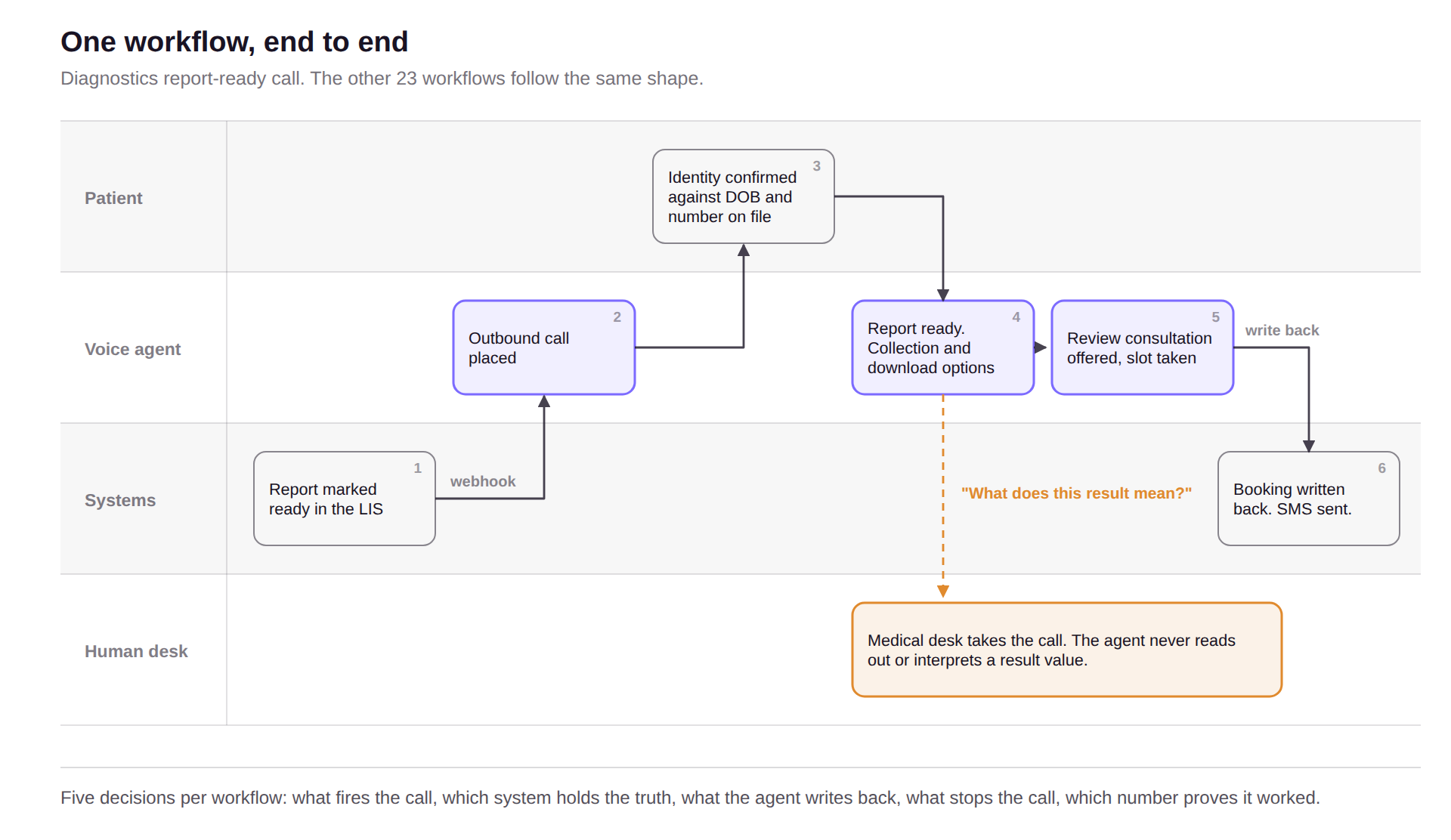
Every one of the 24 has this anatomy. Something fires the call, one system holds the truth, the agent writes an outcome back, a defined condition stops the call, and one number proves it worked.
The 24 AI voice agent use cases in healthcare
Sorting these by department gives you a menu nobody can act on. Sorting them by what each one needs before it can go live gives you a rollout order.

Phase 1: Inbound, live in weeks
These run on calls already arriving. No consent apparatus, no clinical protocol, and the integration gets proven on inbound volume before you dial anyone.
| # | Workflow | What fires the call | What the agent leaves behind |
|---|---|---|---|
| 1 | Appointment booking and scheduling | Patient calls to book, move or cancel a visit | Booking written to the schedule, SMS confirmation sent |
| 2 | General enquiry | Patient calls for timings, location or doctor availability | Answer given without reaching a person |
| 3 | Bed availability and admission enquiry | Patient or family calls ahead of a planned admission | Availability stated from live census, call routed to admissions |
| 4 | Complaint and feedback registration | Patient calls to raise a complaint | Ticket raised with a reference, priority cases routed to service recovery |
| 5 | Billing, estimate and TPA coverage queries | Patient calls about an estimate, coverage or co-payment | Answer given, anything unresolved logged with a reference |
| 6 | Prescription refill and renewal | Patient requests a refill | Identity and eligibility checked, request routed for pharmacist approval |
| 7 | Home visit and sample collection scheduling | Patient calls to book a home collection | Slot booked against pin code, fasting instructions delivered |
Phase 2: Outbound, once consent and list hygiene are in place
Every one of these dials out, which brings consent capture, DND scrubbing, calling window limits and template approval into scope before the first campaign runs
| # | Workflow | What fires the call | What the agent leaves behind |
|---|---|---|---|
| 8 | Appointment reminders and no-show reduction | Appointment approaching | Attendance confirmed, or a new slot taken on the call |
| 9 | Lab and report availability alerts | LIS marks a report ready | Collection options explained, review consultation offered |
| 10 | Insurance pre-authorisation coordination | Cashless file incomplete before admission | Upload link sent mid-call, submission deadline confirmed |
| 11 | Pre-admission and pre-procedure instructions | Admission or procedure scheduled | Fasting, documents and arrival time delivered, understanding confirmed |
| 12 | Preventive screening outreach | Patient matches an age or history filter | Package explained, appointment booked |
| 13 | Health package and camp campaigns | Camp or package campaign scheduled | Registration captured with a date and time |
| 14 | Lapsed patient reactivation | Last-visit date passes a threshold | Reminder delivered, booking offered |
| 15 | New specialty and doctor-launch outreach | New service line or consultant added | Interest captured, consultation booked |
| 16 | Wellness and membership renewal | Membership nears expiry | Renewal captured before the lapse |
| 17 | Post-visit CSAT survey | Visit or discharge closes | Score and the specific friction point recorded |
| 18 | Patient NPS and detractor routing | Rolling sample across service lines | Score and verbatim captured, detractors routed to service recovery |
Phase 3: Clinical-adjacent, after protocol sign-off
These touch care rather than administration. None launch without a written protocol and a red-flag set approved by a clinical lead, which is the constraint rather than the technology.
| # | Workflow | What fires the call | What the agent leaves behind |
|---|---|---|---|
| 19 | Post-discharge recovery check-in | Discharge event, at day 2, 7 and 30 | Answers written to the care management worklist, red flags transferred live |
| 20 | Medication and care-plan adherence | Adherence schedule for enrolled patients | Adherence captured as structured data, refill gaps flagged |
| 21 | Chronic-disease programme enrolment | Care team flags the patient eligible | Consent to enrol recorded against the record |
| 22 | Review visit reminders | Review interval elapses in the HIS | Slot booked before the call ends |
| 23 | Vaccination and immunisation reminders | Dose falls due against date of birth | Schedule explained, appointment booked |
Outside the patient journey
| # | Workflow | What fires the call | What the agent leaves behind |
|---|---|---|---|
| 24 | Clinical and support staff hiring screening | New application received | Registration status, languages, availability and notice period written to the ATS, interview booked |
Which AI voice agent workflow should healthcare institutions automate first?
Start with inbound appointment booking. It carries the highest call volume in most provider organisations, runs on bounded rules with no clinical risk, and turns an abandoned call into a booking you can measure inside 90 days. Diagnostics networks are the exception, and should start with report availability alerts.
A good first workflow has high volume, bounded rules, low clinical risk, and a number you can measure inside 90 days. Which one clears that bar changes with the institution.
Multi-site specialty group: start with appointment booking
Start with workflow 1. A small central team is absorbing every call type and losing the overflow, and booking is both the highest-volume intent and the one where an abandoned call costs revenue directly. Acute symptoms route to the triage nurse line from day one.
Measure: containment on scheduling calls, abandonment before and after, after-hours bookings captured, slots refilled from cancellations.
US health system: start with overflow and after-hours coverage
Start with workflows 1 and 2, scoped to overflow. You already have a functioning contact centre, and replacing it invites resistance from the people you need on side. Put the agent on peak overflow and everything arriving outside staffed hours instead. Nobody changes how they work, and you get a clean before-and-after on abandonment.
Measure: abandonment at peak, after-hours volume converted to bookings, speed to answer during the morning surge.
Multi-state Indian chain: start with the multilingual switchboard
Start with workflows 1 and 3 across your live language set. Language is the binding constraint before anything else, so prove the switchboard in the languages your circles actually speak before adding call types. Booking and bed availability carry most of the volume, and both read from the HIS on day one.
Measure: containment by language, switchboard load, speed to answer at peak, booking conversion.
Diagnostics network: start with report availability alerts
Start with workflow 9, because the trigger already exists and the LIS fires it without anyone building anything. That one sits in Phase 2, so run the consent and DND work in parallel with workflow 7, home collection scheduling, which needs none of it.
Measure: inbound call reduction on report status, collection slot utilisation, sample rejection rate, consultation conversion.
Why do healthcare voice AI deployments fail?
Six things.Turn latency above 800ms, language detection that collapses on real patient speech, read-only access to the scheduling system, no written escalation taxonomy, outbound campaigns that dial before consent infrastructure exists, and a HIPAA posture assumed to cover Indian operations. All six are visible before you sign, and each has one question that surfaces it.
Turn latency above 800ms breaks the conversation
End-to-end turn latency measures the gap between the patient finishing a sentence and the agent starting. Human turn-taking sits near 200ms. Past roughly 800ms, callers assume the line dropped and start speaking again, which breaks interruption handling for the rest of the call. The p95 decides how the system feels, so a platform averaging 600ms with a tail to 3 seconds performs worse than one holding steady at 900ms.
Ask:What is your turn latency at p50 and p95, and your barge-in response time, measured on our telephony route rather than in your demo environment?
Language detection at call open fails on real speech
Patients do not speak one language per call. A system that detects Hindi at the top of the call and then fails on the English fragments will break on the majority of real conversations in an Indian hospital contact centre, as will a system that makes the caller pick a language and stay inside it. Coverage counts also say nothing about dialect, and Bengali in Kolkata and Bengali in Silchar are different inputs.

Ask: Which dialects do you cover, can you handle code-switching inside one utterance, and what is your word error rate on medical vocabulary rather than general speech?
Read-only scheduling access produces a call-back message
An agent that can see availability but cannot write to it costs money to tell patients what they already suspected. Failure behaviour matters as much as the happy path, because a graceful callback capture and a broken conversation look identical in a demo.
Ask: Can you write bookings, reschedules, cancellations and waitlist entries to our scheduling system, have you integrated with our specific HIS before, and what does the agent do when that system is unavailable mid-call?
An unwritten escalation taxonomy has not been built
The most important design work defines what the agent refuses to do. Emergency detection runs deliberately over-sensitive, because a false transfer costs a few minutes of staff time and a missed one has no ceiling. Clinical questions route to humans, and that boundary has to survive a patient asking the same thing four different ways. Low recognition confidence on a drug name triggers explicit confirmation or a transfer.
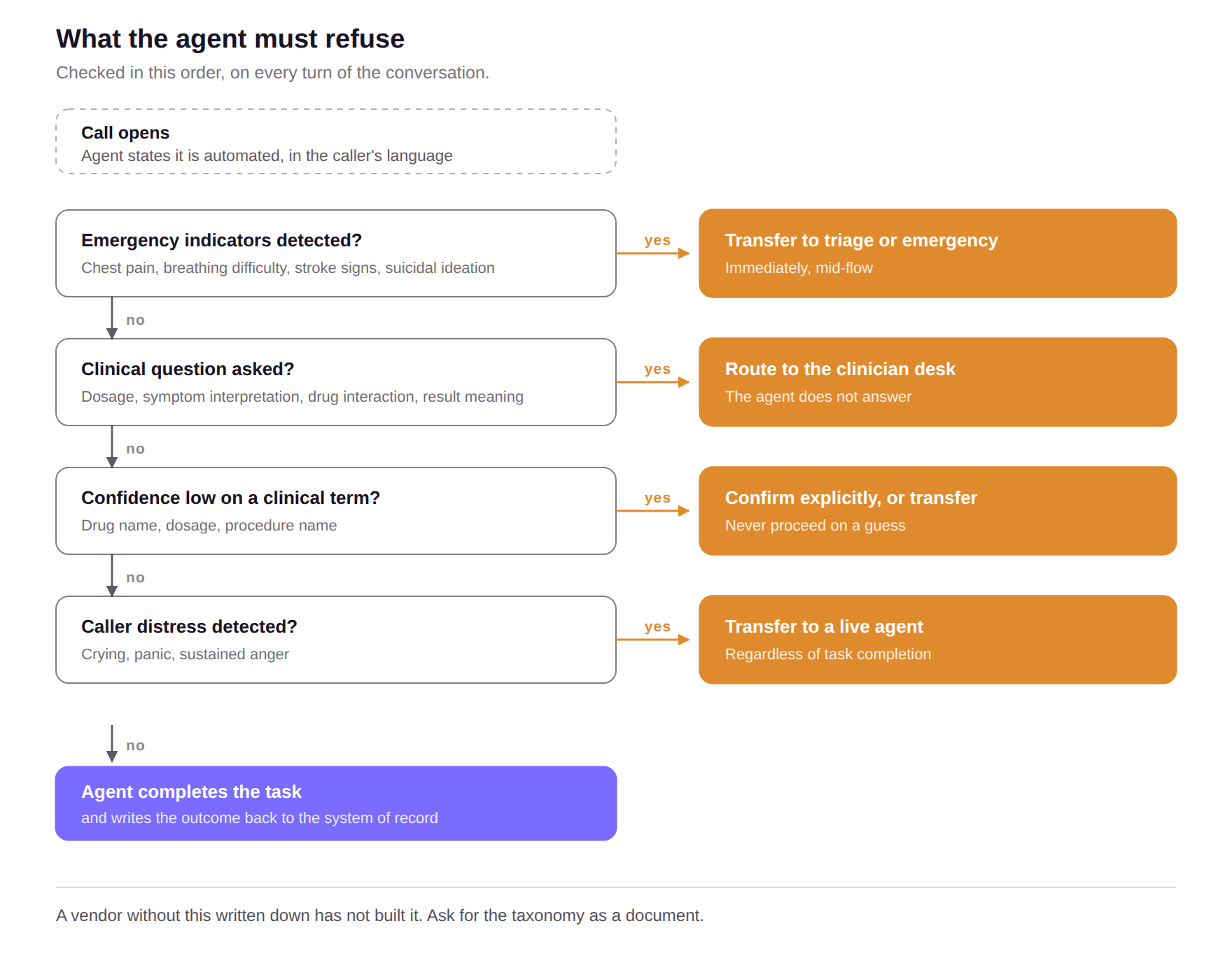
Ask: Show me your escalation taxonomy as a written document, including the emergency red-flag set and who signed it off.
Outbound campaigns fail on consent before they fail on technology
Every Phase 2 workflow dials out. Indian outbound calling carries TRAI obligations covering DND scrubbing, consent registration, calling windows, and header and template approval. US outbound carries TCPA rules governing cadence and the revocation path. A campaign that dials an unscrubbed list is a regulatory incident rather than a performance problem.
Ask: How does the platform enforce DND scrubbing, consent registration and calling windows, and where is consent recorded against the patient record?
HIPAA posture does not cover Indian operations
HIPAA covers a US-only provider. Serving Indian patients or running a global footprint brings four further regimes with separate obligations.
| Regime | Applies to | What it adds to a voice deployment |
|---|---|---|
| HIPAA (US) | PHI at covered entities and business associates | BAA, encryption, access control, audit logging, breach notification |
| DPDP Act (India) | Indian data principals | Consent with clear notice, purpose limitation, data principal rights, breach reporting |
| ABDM / ABHA (India) | Records on the national health stack | Consent artefacts, HIE-CM flows, ABHA-linked identity |
| TRAI (India) | Outbound commercial voice | DND scrubbing, consent registration, calling windows, template compliance |
| GDPR (EU) | EU data subjects | Lawful basis, DPIA, residency, erasure rights |
Two points sit in the architecture rather than the contract. Residency constrains where speech recognition runs, where the model runs, and where recordings live, and platforms assembled from external speech and language APIs cannot guarantee it, because data leaves on every conversational turn. Separately, speaker embeddings generated for voice authentication are biometric identifiers under DPDP and GDPR.
Ask: Where does our data physically reside, including every subprocessor and third-party model in the call path, do you store voiceprints, and does our patient audio train any model?
Gnani AI voice agents for healthcare: how they handle the six failure modes
Gnani AI builds voice agents for healthcare on a stack it owns end to end: speech recognition, voice-tuned small language models, and text to speech, across 40+ languages including 12+ Indian languages. That single fact answers the first two failure modes together. Owning every layer removes third-party API hops from the call path, which is what keeps turn latency down, and code-switching is handled inside the recognition layer rather than bolted on as language detection after the fact.
The sixth follows from the same architecture. A stack built and run in-house does not have to send patient audio out of the deployment on every conversational turn, which is the precondition for Indian data residency sitting alongside HIPAA-aware workflows. Provider groups operating across both markets need both at once, and platforms assembled from external APIs have to pick one.
Failure modes three, four and five are claims any vendor can make and none can prove in a slide. Take nothing here on trust. Put the questions above to us and to everyone else on your list, and compare the answers.
Frequently Asked Questions
What is the difference between an AI voice agent and an IVR?
An IVR moves a caller through a fixed menu using keypresses or constrained speech, then hands them to a queue. An AI voice agent understands open speech, handles multi-part requests, and completes the task in your scheduling or record system. The measurable difference is task completion rather than call routing.
Are AI voice agents in healthcare HIPAA compliant?
Compliance attaches to a deployment rather than to a platform. You need a vendor that signs a BAA, encryption in transit and at rest, role-based access control, audit logging, and a defined breach notification process. Indian operations carry DPDP obligations independently of HIPAA, and outbound calling adds TRAI consent requirements.
Is voice AI compliant with the DPDP Act for health data in India?
It can be, provided the deployment captures lawful consent with clear notice, limits processing to the stated purpose, keeps data resident where required, supports data principal rights, and meets breach reporting duties. Residency depends on where speech recognition and models actually run, so verify the deployment topology rather than the contract.
How much do AI voice agents for healthcare cost?
Pricing runs per minute, per call, or per successful resolution. The quoted rate rarely includes telephony, integration build, and ongoing support, so establish what sits outside it. Compare against your fully loaded cost per handled call rather than against a competitor list price.
How long does deployment take for a hospital?
A bounded single use case on a standard integration takes weeks. A multi-language, multi-site rollout with custom HIS work and full compliance review takes months. A vendor quoting days is describing a demo rather than a production deployment with identity verification and tested escalation logic.
Can AI voice agents triage patient symptoms over the phone?
They should route rather than assess. Systems attempting clinical triage create liability and patient safety exposure that no efficiency gain covers. The safe pattern identifies what the caller needs, detects emergencies, and moves the patient to the right clinical desk.
Can voice AI handle abnormal lab result notifications safely?
Notification should cover readiness and collection instructions only. Communicating or interpreting an abnormal result belongs with a clinician, and a correctly configured agent detects that request and transfers the call.
Will AI voice agents replace our call centre staff?
The common outcome redeploys staff onto complex and clinical calls while the agent absorbs volume the team was not reaching, particularly after hours and during peak overflow. Most first-year value comes from calls that previously went unanswered.
